
November 1, 1975 · TAP
TAP No. 30 - Party Lines, Fortress Extension & Locks
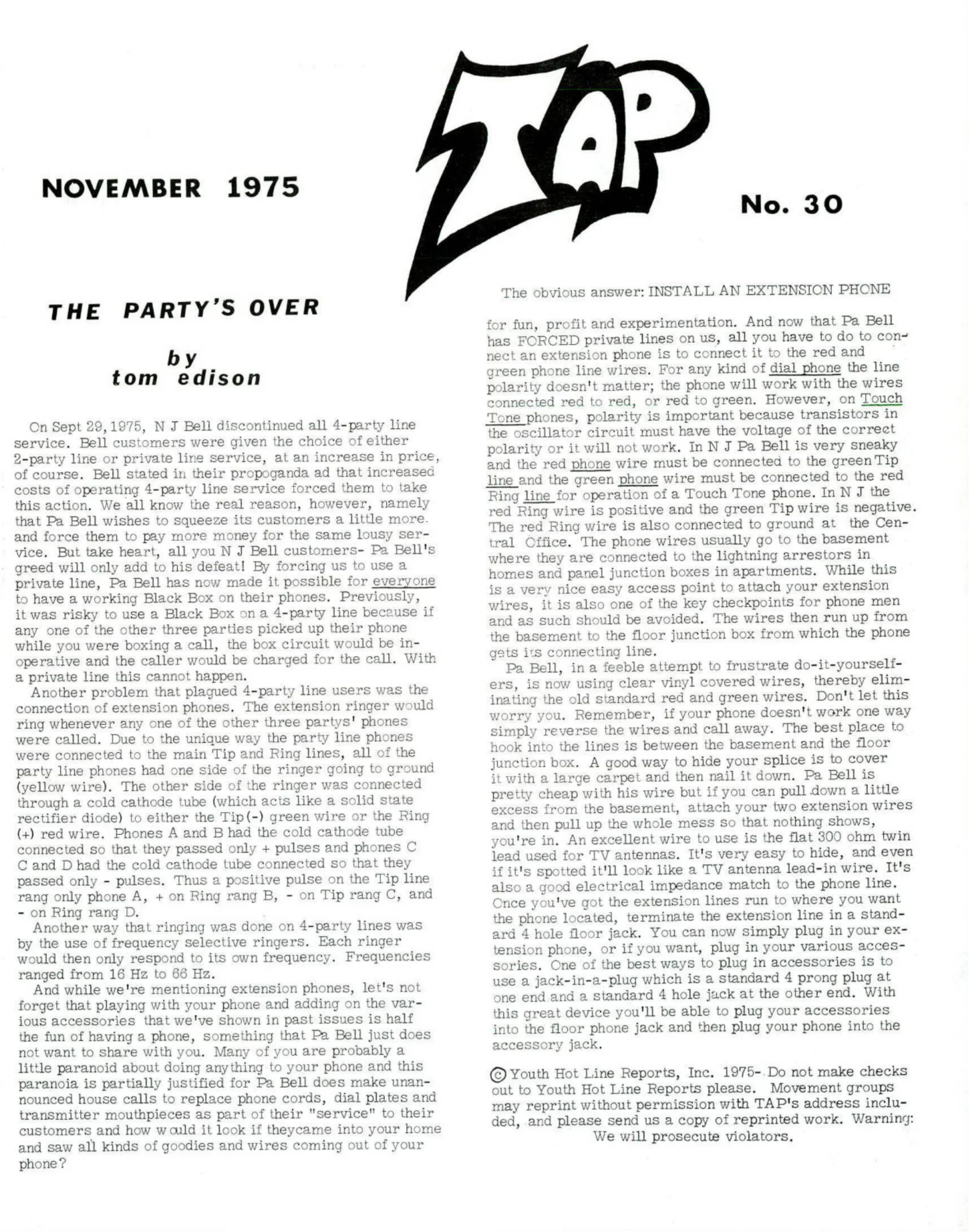
Columnist ‘Tom Edison’ covers New Jersey Bell’s discontinuation of shared party lines, framing it as a rate-hike tactic thinly disguised as a customer favor, and walks through wiring a home extension phone (including hiding the splice) now that private lines are mandatory. A ‘Fortress Fun’ piece covers repurposing a discarded ‘Fortress’ payphone as an extension, and a telephone-locks feature bluntly tells readers not to bother trying to pick residential lock hardware.
NOVEMBER 1975
THE PARTY’S OVER
by
tom edison
On Sept 29,1975, N J Bell discontinued all 4-party line
service. Bell customers were
given the choice of either
2-party line or private line service, at an increase in price,
of course. Bell stated in their propoganda ad that increased
costs of operating 4-party line service forced them to take
this action. We all know the real reason, however, namely
that Pa Bell wishes to squeeze its customers a little mo.
and force them to pay more money for the same lousy ser-
vice. But take heart, all you N J Bell customers- Pa Bell's
greed will only add to his defeat! By forcing us to use a
private line, Pa Bell has now
made it possible for everyone
to have a working Black Box on their phones. Previously,
it was risky to use a Black Box ona 4-party line because if
any one of the other three parties picked up their phone
while you were boxing a call, the box circuit would be in-
operative and the caller would be charged for the call. With
a private line this cannot happen.
Another problem that plagued 4-party line users was the
connection of extension phones, The extension ringer would
ring whenever any one of the other three partys' phones
were called. Due to the unique way the party line phones
were connected to the main Tip and Ring lines, all of the
party line phones had one side of the ringer going to ground
(yellow wire). The other side of the ringer w as connected
through a cold cathode tube (which acts like a
solid state
rectifier diode) to either the Tip(-) green wire or the Ring
(+) red wire. Phones A and B had the cold cathode tube
connected so that they passed only + pulses and phones C
Cand D had the cold cathode tube connected so that they
passed only - pulses. Thus a positive pulse on the Tip line
rang only phone A, + on Ring rang B, - on Tip rang C, and
- on Ring rang D.
Another way that ringing was done on 4-party lines was
by the use of frequency selective ringers. Each ringer
would then only respond to its own frequency. Frequencies
ranged from 16 Hz to 66 Hz.
‘And while we're mentioning extension phones, let's not
forget that playing with your phone and adding on the var-
ious accessories that we've shown in past issues is half
the fun of having a phone, something that Pa Bell just does
not want to share with you. Many of you are probably a
little paranoid about doing anything to your phone and this
paranoia is partially justified for Pa Bell does make unan-
nounced house calls to replace phone cords, dial plates and
transmitter mouthpieces as part of their "service" to their
customers and how would it look if theycame into your home
and saw all kinds of goodies and wires coming out of your
phone?
No. 30
The obvious answer: INSTALL AN EXTENSION PHONE.
for fun, profit and experimentation. And now that Pa Bell
has FORCED private lines on us, all you have to do to con~
nect an extension phone is to connect it to the red and
green phone line wires. For any kind of dial phone the line
polarity doesn't matter; the phone will work with the wires
connected red to red, or red to green. However, on Touch
Tone phones, polarity is important because transistors in
the
oscillator circuit must have the voltage of the correct
polarity or it will not work, In N J Pa Bell is very sneaky
and the red phone wire must be connected to the green Tip
line and the green phone wire must be connected to the red
Ring line for operation of a Touch Tone phone. In N J the
red Ring wire is positive and the green Tip wire is negative.
The red Ring wire is also connected to ground at the Cen-
tral Office. The phone wires usually go to the basement
where they are connected to the lightning arrestors in
homes and panel junction boxes in apartments. While this
is a very
nice easy access point to attach your extension
wires, it is also one of the key checkpoints for phone men
and as such should be avoided. The wires then run up from
the basement to the floor junction box from which the phone
gets its connecting line.
Pa Bell, ina feeble attempt to frustrate do-it-yourseli-
ers, is now using clear vinyl covered wires, thereby elim-
inating
the old standard red and green wires. Don't let this
worry
you. Remember, if your phone doesn't work one way
simply
reverse the wires and call away. The best place to
hook into the lines is between the basement and the floor
junction box. A good way to hide your splice is to cover
jt with a large carpet and then nail it down. Pa Bell is
pretty cheap with his wire but if you can pull down a little
excess from the basement, attach your two extension wires
and then pull up the whole mess so that nothing shows,
you're in, An excellent wire to use is the flat 300 ohm twin
lead used for TV antennas. It's very easy to hide, and even
if it's spotted it'll look like a TV antenna lead-in wire. It's
also a
good electrical impedance match to the phone line.
Once you've got the extension lines run to where you want
the phone located, terminate the extension line in a stand-
ard 4 hole floor jack. You can now simply plug in your ex-
tension phone, or if you want, plug in your various acces-
sories, One of
the best ways to plug in accessories is to
use a jack-in-a-plug which is a standard 4 prong plug at
one end and a standard 4 hole jack at the other end. With
this great device you'll be able to plug your accessories
into the floor phone jack and then plug your phone into the
accessory jack.
© Youth Hot Line Reports, Inc. 1975-.Do not make checks
out to Youth Hot Line Reports please. Movement groups
may reprint without permission with TAP's address inclu-
ded, and please send us a copy of reprinted work. Warning:
We will prosecute violators.
FORTRESS FUN
by
tom edison
A Fortress makes an excellent extension phone. Should
you come across one lying in the road or sticking out of a
trash barrel behind TPC's office, it is your public duty to
remove this hazard to prevent it from falling into enemy
hands. Once you have sneaked it safely into your home and
are satisfied that the men from Department "S" have not
seen you getting a hernia as you carried it down the street
wrapped ina blanket, you may safely unwrap it for closer
inspection.
There are four wires connected to the Fortress. For
home use, connect the red Ring phone line to the red wire
and the green Tip phone line to the green wire. The ringer
is across the red and green wires so that you can receive
incoming calls simply by lifting the receiver off the hook.
In order to make a call, however, you must deposit 10¢
but have no fear, since it's your phone and you're playing
operator, simply connect the output of a power supply
capable of generating a + 50 vdc, at 40 ma. to the yellow
ground wire and the negative side of the power supply to
the green Tip or red Ring wire. This 50 vdc. pulse (neg-
ative with respect to ground) will drop the deposited coins
into the coin return slot. A positive 50 vde. pulse sent
down either the Tip or Ring wire will drop the coins into
the coin box, a definite no-no, especially if you don't hap-
pen to have it open yet.
One reader suggested carrying a regular phone into a pay
phone booth, splicing into the pay phone wires, and dialing
away. This will not always work because Pa Bell does not
put 48 vde, battery on the line until you deposit money.
When you deposit money, you trip a switch which places a
10kohm resistance between the yellow ground wire and the
green Tip wire which completes a loop which operates a
relay at the CO which then places 48 vdc. battery on the line.
If you ever have to make a life ordeath emergency call
and you don't have any change but you do have a 10kohm
resistor and a portable telephone with you, try splitting
open the pay phone wire and connecting the 10kohm resistor
that has an alligator clip on each end between the yellow
and green wires of the pay phone. This should get you bat-
tery on the red and green wires. Connect your portable
phone (also equipped with alligator clips) to the red and
green wires and make your emergency call.
Tf you ever have to make another emergency call and you
forget to bring along your 10kohm resistor, you might try
depositing 5¢ without picking up the receiver. This again
should get you battery on the red and green wires. Hook
up your portable phone and dial. To get your 5¢ back (you
cheap bastard) you might try connecting a 50 volt battery
+ terminal to the yellow wire and - terminal to either the
red or green wire. Remember to use these techniques only
for life or death emergencies, like to order a pizza or to
place a bet with your neighborhood bookie (who, if he's
smart, is using a cheese box circuit shown in issue #20).
ACHTUNG!
Beginning in the next issue, we will feature a column
"ASk Mr. Phelps". Send in your questions and he will try
to answer them. Mr. Phelps' field is mechanical devices
and metalworking - research and development - and con-
spiracy masterminding. Questions on electronics will be
given to Barney. If you send a deposit to his bank account
in Zurich, he will make an all-out, maximum effort to
answer you.
TELEPHONE LOCKS
We often fantasize about "picking the lock" or "getting a
master key". Well, you can forget about it. I don't like to
discourage people, but it will save you from wasting a lot
of time - time which can be put to better use (heh, heh). If
these were "the good old days", it would be different. The
old three slotters used a simple lever tumbler "locker" or
"mailbox" lock which could be picked with a couple of mod-
ified Allen wrenches (accept no substitutes). Old timers
tell me they hit two or three boxes every day. They always
contained at least $75 each, and that was back when the $
was worth something and the coins were silver,
It was too good to last. Whatever else I think of The
Phone Company, I must admit that they learn from their
mistakes. TPC added a tubular lock. It was smaller in
diameter that the standard Ace so one couldn't use the
regular blank and key machine. To pick it, one had to make
a very special pick, instead of buying it.
Then TPC brought out the Fortress Phone. The lock
has a hardened surface and the frame has hardened stain-
less steel inserts, It is an eight lever type and highly pick
resistant. Only seven hundred have been picked in the
country, according to a report in an AT&T house organ a
couple of years ago. Each of the eight levers has five
positions, so 5°=390, 625 possible keys. There is no such
thing as a master key for this type of lock. It is difficult
to pick because when you throw each lever, it is easy to
throw it too far and it jams and you have to start all over.
The most practical method is to train fleas to crawl inside
the locks and read the sizes of the levers and then fit indi-
vidual keys to each lock.
One often sees Fortresses bearing indications of unsuc-
cessful assaults. Attacking one with a chisel or crowbar
is a waste of time and energy. The picture of the back of
the cover plate shows how formidable it is. You will note
that hardened stainless steel bolts lock into all four sides,
But like any safe, the Fortress has its vulnerable areas.
When someone (I wonder who?) puts epoxy in the lock, TPC
has to open it somehow without destroying the whole thing,
so they drill in the proper places through the cover and the
rotating plate, which are not hardened, Where do TPC's
employees drill? Well, I imagine they might drill out the
stop at A', drill and punch out the pin atC!, and drill away
the four places marked D. This would permit the one side
bolt to be retracted and permit the plate to rotate, retract-
ing the other three. An alternative method might be to drill
and punch out the four pins, but the stops at
A prevent the
bolts from moving in the guides B. If they then drill out
the stops A, I believe the four bolts can be retracted man-
ually. Gravity helps the top one but hinders the bottom one.
The extension on the side (left in picture) remains in
either case and may necessitate use of a crowbar.
Tam not suggesting that anyone use a battery powered
electric drill with quality cobalt high speed drill bits (not
Canal Street Japanese junk) to rob TPC, Whether the
amount of work and risk required is worth it is something
only the prospective perpetrator can decide. However, if
you are determined to lead a life of crime, it is advisable
to determine how much money is in the box before proceed-
ing. This will cost you 10¢ or a slug. Make a phone call
and when the coin drops into the box, you can tell how full
it is by how it sounds. If it bounces off the bottom, it is
empty; if it quietly slushes in, heh, heh...
One still finds the old three slotters without Ace locks
in some rural areas. GTE, I believe, uses pin tumbler
locks on the left side of the Fortress. Any info you have
about these would be appreciated. Offhand, I would guess
they are reasonably easy to pick, though not as easy as is
shown on TV.
Mr. Phelps
TOP
Right side when
viewed from outside
5 3/4"
4 5/8"
>
Coin's eye view
of Cover Plate
Drawing may not be exact size due to alteration during printing process
Letters From Readers
Dear TAP,
Theta the pay TV company has gotten wise to 2+8=Z (Issue
#217) and put a scrambler on all non-Z lines. It's a resis-
tance filled white box on the telephone pole where the house
cable joins the main line. Easy to remove or to bypass its
guts with a simple co-ax wire. So Z is still free if you can
climb a telephone pole.
-CALIFORNIA-
Dear TAP,
How elaborate a design do you seek for a radio jammer?
You may know already that it takes a signal only slightly
stronger than the "bonafide" one to completely block an
FM station. You know about capture ratio...So, if one is
sufficiently close to the victim receiver with his small FM
oscillator, you can kill the legitimate broadcast (or even
utility) service. I built a small (single) transistor oscil-
lator, tunable, to kill the offending audio in the apartment
next door. If you radiate a clean signal (no audio modu-
lation) you can completely silence an FM set, I suspect
the effort required on an AM station, to be successful,
would be too great, needing much more power, not to
mention antennas. Here, we rely on the nuisance value of
heterodyning against the "bonafide" signal; it simply makes
it difficult or unpleasant to hear, But, you don't wipe it
out unless you're really hosing some power! Might as
well concentrate only on FM stations. HMMM,,.It sure
would take a lot of jammers to put the NYC pigs out of
business, but it might be somewhat easier if one jammed
their repeaters. Guess they have a few.
-SINBAD-
Inflation Hits TAP
You know what that means, For four years we've kept
the price at $2, which isn't much. Compare that to your
monthly phone bill. Starting Dec. 1, bulk rate 10 issue
subscriptions will be $4, the first-class sealed rate and
Canada stapled rate will be $6, and the foreign surface
rate will be $7. An establishment newletter of equal value
would cost at least 5 times as much. Unlike them, we will
continue to send free subscriptions to indigent students,
prisoners, and others who explain to us why they can't
afford to pay.
So you won't think we're getting rich on it, here's what
the money will be going for: Increased postage and printing
costs, office expenses, and increasing our bail fund at the
insistence of our more paranoid volunteers. Al Bell didn't
want to raise the rate but finally agreed to, when we agreed
not to defenestrate him.
Here is our revised Destructory Assistance list. See
previous issues for trading conditions.
Phones
Laws,
Black, Blue, &Red Boxes
Electronics
Bell Reprints
Chemistry
Bugs and Scramblers
Pol:
Radio
& TV
Interesting phone #s
Cuedit Cards
Test numbers
Installation & attachments
Payphones
Domestic & Foreign Codes
Locks and Security
Vending Macaines
Slugs and Foreign Coins
Personal Survival
Ui
ies (Electric & Gas)
Miscellaneous
We need info on:
Vending Machines- locks, techniques for getting your
money's worth,
Locks- code books, picking methods, safe manipulation,
sources of supply.
Radio- pirate stations, jammers, etc.
Cable TV-
tapping into the line.
tilities- info on N, J, Public Services' round ceramic
electric meter seals.
Burglar alarms- Holmes & other central station systems.
Printing- methods, magnetic ink used in printing checks, etc.
Published for informational purposes only by Youth Hot Line Reports, Inc.
Address all mail and checks to -
PAID
TAP, ROOM S04, 152 W. 42 ST., N.Y,N.Y. 10036
@ Credit Card Scanner
‘A holographic memory unit that can check a
credit card holder's rating within three seconds is
now being manufactured in California.
The
device—which spells doom to con men or
those who utilize stolen credit cards—is already being
used by several hotel chains. In addition, some
gambling casinos in Las Vegas have installed the
rized mechanism is keyed to a laser
beam and permits as many as 700,000 credit ratings
to be put on a 30-foot strip of 35-millimeter film,
‘The memory unit is used only to keep track of
bad
credit risks. By inserting the credit card into the
device,
it ean be determined whether or not the card
holder is on the list of bad risks.
The International Teamster
Back Issues-Listed by feature articles
50¢ each, 40¢ each if complete set is ordered.
1-Extensions, Conierence Switches
2-Blue Box Story and Abbie on Ripoffs
3-Telecommand Story
4-Pay Phone Issue
ceed
Early Model
7- Tuning your organ, 3-slot ripoffs
8-Credit Card Calls/1972 Code
9
10 Black Box
ir
12 Blue Box Plans
13 Int'l calls & Codes, Bluebox plans
14 More codes, AT&T Papers, Ca. Test numbers
15 1973 Credit Card Code, T network
16 Red Box plans
17 Red Box, Line Relay, Don't Get Busted
18 Outgoing long distance call stopper
19 Snoop light, Taping Fortress tones
20 Cheese Box(Conference line, or loop-arounu)
21 Automatic Phone Tap, Convention Report
22 Answeroo, "How we catch Red Boxers"
23 Free Electricity
24 Fraud Detectors, Index of TAP issues, 1974 CC Code
25 New Red Box, Free Gas
26 New Bluebox, Con Ed key (also 23, 29)
27 Free Electricity, Blue Box Correction
28 Reading Computer bills, loop suffixes
29 Improved Bluebox & Snooplite, Int'l codes
FACT SHEETS -25¢ each
1. Credit Card Calling Hints
2, Receiving Long Distance Calls Free
(Same as Issue 11 for General Telephone Co.
Customers instead of Bell Telephone Co.)
Displayed Red Box
2600 Whistle Berieci
50¢ per set.
Dual tone oscillator:
Anti-Bell Button-50¢ 10/$3
BOOKS
Steal This Book-$2, 25
Monopoly -
$1.20
Courses-50¢ each: A-Basic Electricity, B-Alternating
Current, C-Basic Phone Operation, D-Amplifiers,
Send Check or Money order only to ‘TAP
Address: Room 504, 152 W. 42 St, New York 10036
(This is a Mail Drop only)
Office: 1201 Broadway, Rm. 608, Wed. 4-7 pm.
NYC 10001
BULK RATE
U, S. POSTAGE
Permit No. 209
Great Neck, N.Y.