
May 1, 1978 · TAP
TAP No. 50 - Special 7th Anniversary Double Issue: Tandem Scanning, Free Cable TV, Making Lock Picks
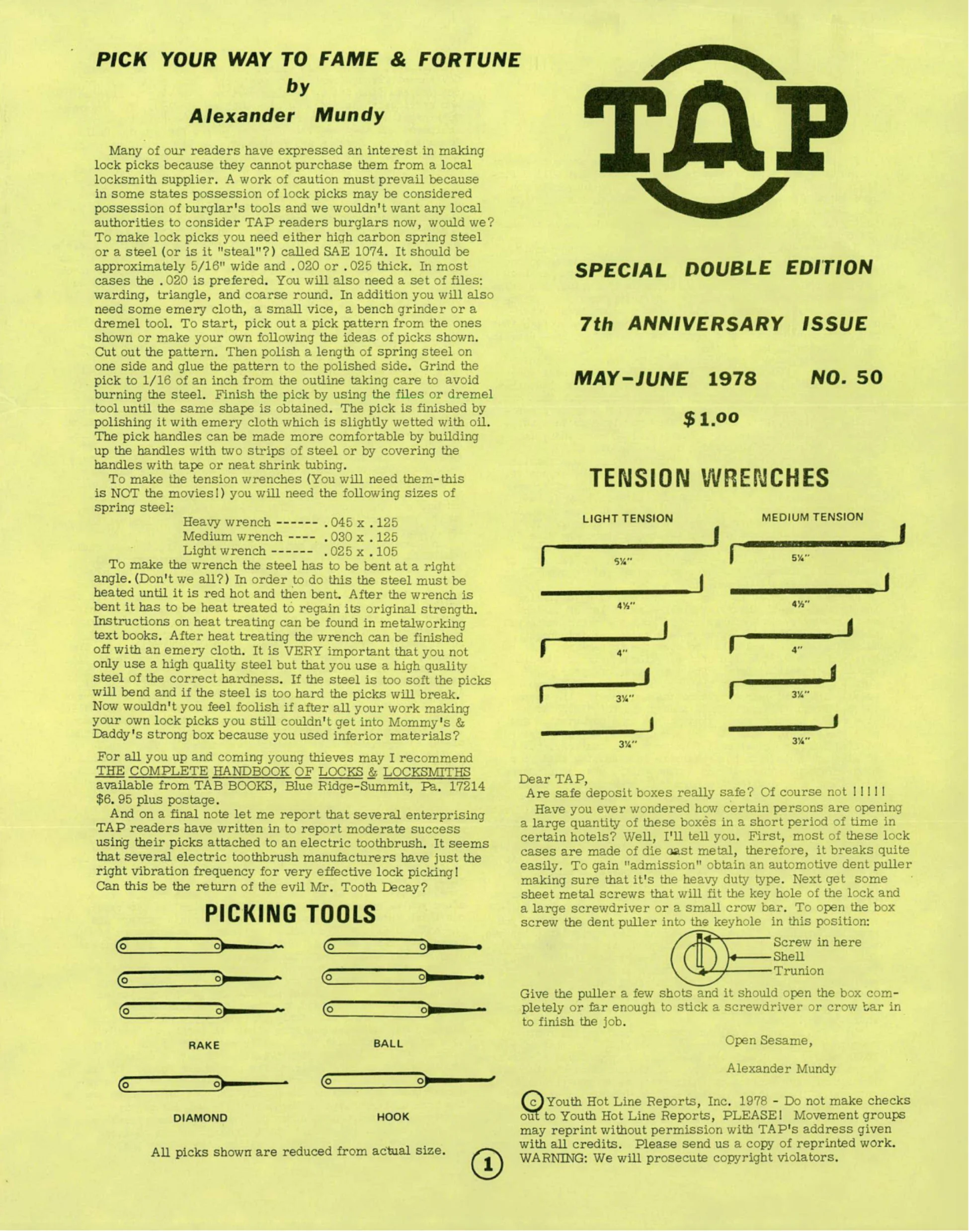
TAP’s 7th anniversary double issue opens with a step-by-step guide (by ‘Alexander Mundy’) to fabricating lock picks and tension wrenches from spring steel. A second feature, ‘Electronics for the Dope Dealer,’ walks drug dealers through countersurveillance — detecting phone taps, spotting body wires, and scanning police/federal radio frequencies — followed by pieces on cable TV descrambling and other schemes, reflecting the era’s drift from pure phone phreaking toward broader anti-establishment ‘countereconomics’ content.
PICK YOUR WAY TO FAME & FORTUNE
by
Alexander Mundy
Many of our readers have expressed an interest in making
lock picks because they cannot purchase them from a local
locksmith supplier. A work of caution must prevail because
in some states possession of lock picks may be considered
possession of burglar's tools and we wouldn't want any local
authorities to consider TAP readers burglars now, would we?
To make lock picks you need either high carbon spring steel
or a steel (or is it "steal"?) called SAE 1074. It should be
approximately 6/16" wide and .020 or .025 thick. In most
cases the .020 is prefered. You will also need a set of files:
warding, triangle, and coarse round. In addition you will also
need some emery cloth, a small vice, a bench grinder or a
dremel tool. To start, pick out a pick pattern from the ones
shown or make your own following the ideas of picks shown.
Cut out the pattern. Then polish a length of spring steel on
one side and glue the pattern to the polished side. Grind the
pick to 1/16 of an inch from the outline taking care to avoid
burning the steel. Finish the pick by using the files or dremel
tool until the same shape is obtained. The pick is finished by
polishing it with emery cloth which is slightly wetted with oil.
‘The pick handles can be made more comfortable by building
up the handles with two strips of steel or by covering the
handles with tape or neat shrink tubing.
To make the tension wrenches (You will need them-this
is NOT the movies!) you will need the following sizes of
spring steel:
Heavy wrench -:
045 x .125
Medium wrench -
-030 x .125
Light wrench
+025 x .105
To make the wrench the steel has to be bent ata right
angle. (Don't we all?) In order to do this the steel must be
heated until it is red hot and then bent. After the wrench is
bent it has to be heat treated to regain its original strength.
Instructions on heat treating can be found in metalworking
text books, After heat treating the wrench can be finished
off with an emery cloth. It is VERY important that you not
only use a high quality steel but that you use a high quality
steel of the correct hardness, If the steel is too soft the picks
will bend and if the steel is too hard the picks will break.
Now wouldn't you feel foolish if after all your work making
your own lock picks you still couldn't get into Mommy's é&
Daddy's strong box because you used inferior materials?
For all you up and coming young thieves may I recommend
THE COMPLETE HANDBOOK OF LOCKS & LOCKSMITHS
available from TAB BOOKS, Blue Ridge-Summit, Pa, 17214
$6. 95 plus postage.
And on a final note let me report that several enterprising
TAP readers have written in to report moderate success
using their picks attached to an electric toothbrush. It seems
that several electric toothbrush manufacturers have just the
right vibration frequency for very effective lock picking!
Can this be the return of the evil Mr. Tooth Decay?
PICKING TOOLS
IK
K
RAKE
BALL
|
|
DIAMOND
HOOK
All picks shown are reduced from actual size. ©)
m—,
A
SPECIAL DOUBLE EDITION
7th ANNIVERSARY ISSUE
MAY-JUNE 1978
NO. SO
$1.00
TENSION WRENCHES
LIGHT TENSION
MEDIUM TENSION
exe
5K"
ayn
ay"
Dear TAP,
‘Are safe deposit boxes really safe? Of course not 11111
Have you ever wondered how certain persons are opening
a large quantity of these boxés in a short period of time in
certain hotels? Well, I'll tell you, First, most of these lock
cases are made of die cast metal, therefore, it breaks quite
easily. To gain "admission" obtain an automotive dent puller
making sure that it's the heavy duty type. Next get some
sheet metal screws that will fit the key hole of the lock and
a large screwdriver or a small crow bar. To open the box
screw the dent puller into the keyhole in this position:
Screw in here
Shell
‘Trunion
Give the puller a few shots and it should open the box com-
pletely or far enough to stick a screwdriver or crow tar in
to finish the job.
Open Sesame,
Alexander Mundy
Qgouts Hot Line Reports, Inc. 1978 - Do not make checks
out to Youth Hot Line Reports, PLEASE! Movement groups
may reprint without permission with TAP's address given
with all credits. Please send us a copy of reprinted work.
WARNING: We will prosecute copyright violators.
Electronics for the Dope Dealer
Se
—peerieeenir
ory
How to Beat The Man
by Don Victor Harbolt
If you're into dealing or smuggling, there are a number of
precautions and countermeasures you can take that will defin-
itely inerease your chances of survival. No longer do you
have to be a paranoid personality in order to suspect that
your telephone is tapped, that someone is following you, or
‘that your best friend is wearing a bug when he comes to make
his next buy.
No matter what you read or hear, there is no perfectly
reliable way that you can use to find out if your telephone
‘s bugged. If you ask the telephone company to run a check
and your local law enforcement agency is listening, the tele~
phone company will cheerfully report that there's not a bug
anywhere on your line. Sophisticated equipment for deter-
mining if you're bugged is very expensive and more often than
not, it's subject to false reporting - or worse, non-reporting.
So, it logically follows that if you can't make sure your
line is clear, don't say anything
on it that you wouldn't
want Clarence Kelley to
hear.
"3 easy to call back your
friends from a pay station when they want to talk about that
last Kilo or the next one, To make perfectly sure that our
boys in blue don't stumble onto you because they were moni~
toring his line, it's suggested that you tdth go to a tele-
phone booth and discuss your dealing...and even then, it
wouldn't be cool to keep going to the same booth.
Occasionally, friends will ask me about voice scramblers
for using with the phone. These instruments are expensive
and aren't that secure. If you simply need time after your
Phone conversation, these units will give it to you, but
the Government has equipment that can decode these recorded
conversations - whether it takes an hour or a week, The
more sophisticated units use e technique where the code is
changed every few moments, thus the unscrambling is made
that much more difficult. Expect to pay $4 000 for ‘each of
these units, though, One manufacturer of this equipment is
Technical Materials Company.
Another method of keeping your freedom is by utilizing
the "pocket-pager" that's available froma lot of the en-
swering services, Whenever one of your customers wants to
play "Let's Make a Deal", he merely calls the telephone
answering service and asks the operator to page you and
have you call Fred at the office, without telling her the
number he's calling from, She then picks off your page
number and a pocket pager that you hide on your person
beeps. You then depress the button and receive the message
to call Fred. You previously made plans for "Fred" to be
at a pre-determined mumber and you go to a pay station and
give him a call, This has the advantage of not only never
missing that important call from your best customer, but
it also prevents your best customer from knowing what your
home telephone number is and consequently, what your address
is. There's no implication here that your customer might be
dissatisfied with your product, but rather, that he got busted
and has been playing a little "Let's Make a Deal" himself with
The Man. If you really want to get slick, you can use a call
diverter which simply is a device that dials you at another
number whenever your usual line rings, and then automatically
connects you with the calling party wherever you are, This
system, when used with the Royaphone®, makes an extremely
secure system, The Rovaphone™ is a device that transmits
your calls over a radio frequency. So, you put the trans-
mitter (which connects to your regular telephone line) in an
apartment, and acrgss the street, where you really live, you
have the Rovaphone™ itself, It looks like a regular telephone,
but instead of having a cord coming out, it has an antenna,
Your call is received in the "empty" apartment and is then
transmitted to your phone in another nearly apartment. This
way, when the nares come busting in after finding out what
your address is through your telephone listing, they're
confronted with an empty apartment ~ no stash or dealer any~
where to be found,
In a lot of instances, it's wise to monitor the radio
frequency of the Drug Enforcement Agency(DEA) or that of your
local nares, Receivers are available at your local electronics
store that do this very nicely, If the constant chatter and
screech of cops talking on their radio makes you paranoid, then
get one of the units which has a built-in cassette recorder
which records these calls. Then you can sit down at the end
of the day when your head's together and review what all tran-
spired during the preceding twenty-four hours in about thirty
minutes, Many electronics stores will be happy to supply you
with crystals for your receiver that are on the appropriate
frequencies. There is an exception, and that's the Federal
Government frequencies, Very few people know what they are
but you can find out by getting next to a two-way technician
who services these units (a kilo will do nicely), The Federal
Government uses only General Electric and Motorola two-way
equipment and they're listed in the Yellow Pages under Radio
Communications Service and Equipment,..so let your fingers do
the walking. Most of thes frequencies (FBI, DEA, Border
Patrol, etc.) are in the 168-170 mz portion of the spectrum,
with the exception of some areas near the borders where they
use a 450nHz repeater system. As of now, few (CIA & Secret
Service) of the Federal agencies are using scramblers, If
they should ever go to them, then try using a descrambler,
A number of good models are made by PDQ Electronics in North
Little Rock, Arkansas. Also, if you're a traveling man, there's
a directory of police frequencies available from Commnicationa
Company, P.0.Box 56, Commack, NY. It's best, however, to check
with @ local electronics dealer to find out what channels the
nares are on,
Possibly you are wondering what you can do to immunize
yourself from being bugged by your best customer when he comes
to score. If he's wired for sound when you make your deal,
you're in real trouble, Most of the units used ere portable
transmitters which allow agents to listen in and to record
this conversation in their car. They operate in the area of
58 to 108 mz, with some Treasury bugs operating on the same
frequency as their two-way radio, Once again, your neighbor-
hood electronics dealer can supply you with a "field strength
meter" which will rat on these rats when they walk in the door
and get close to it. Spend a little extra and get a good one,
It could save you a little time - like about ten years, But
What about the guy who's wired for sound with a miniature tape
recorder? The best protection here is to look your man over
well and have some background misic playing while you discuss
the pertinent parts of your transaction. Some of these re-
corders are the size of a billfold, so use caution, However,
on the small units playing and recording time is limited to
about thirty minutes,
In increasing numbers dealers have been using two-way redio
equipment themselves in order to get their game dow tight,
In one instance, it caused a bust. The dealer made his mis-
take by using a mobile telephone and a housewife who was also
@ radio amateur and had nothing better to do than eavesdrop on
mobile calls, reported him to the Arizona narcs. Mobile tele~
phones are definitely no-no, They aren't private by any means,
If you need good, dependable radio communications equipment,
go to used FM commercial two-ways in the 30-50 mHz band, The
chances of somebody overhearing you are small, Even then, it's
good not to openly discuss the going prices and where The Man
is. Use a simple code that you can work up in a few minutes,
Anyone hearing "121 a code 3, section 2 at 4" would never guess
that it means a highway patrol unit with a roadblock four miles
shead. Citizens band units are a joke and should never be used.
These commercial units, unlike citizen's band, are professional
pieces of equipment like The Man uses himself. They can be
bought cheap from used two-way dealers like Gregory Electronics,
249 Route 46, Saddle Brook, NJ or on the West Coast, try Mann
Communications in Tarzana and Phoenix, The price for a used
General Electric progress line unit can be as low as $100,
It wouldn't be a bad idea to take that "field strength meter"
out to the car occasionally, Walk around your car and check the
meter for movement while the ignition is on, Frequently, The
Man will use a "bumper beeper" to tail you from a distance,
This transmitter lets him, keep up on your location without his
having to get close enough for you to realize he's following
you. If you are bugged with one of these units, you might
consider attaching it to the underside of some police cruiser
after you've removed it, Incidentally, there are two types,
one which obtains it's power from the vehicle's battery and
the other uses a self-contained battery. The advantage of
using your car's power is obvious ~ no more of those embarrass
sing battery changes need take place,
There are a lot of ways to decrease the likelihood of a
bust by using electronics and only a few of them have been
discussed here. Many of the methods are quite complicated
and could even be employed to stop rip-off artists beating
you for your stash, It's only limited ty your imagination,
electronics, and what you Imow about the people who are out
to stop you. Consider the smuggler who flies by the border
radar (ADIZ) ae if they didn't exist. He uses a radar
counter-measures unit designed for the US Air Force. Or the
smiggler who checks the border fences using one of the "star~
scope" units the Army has been using in Viet Nem, These are
‘the more esoteric ways of countering The Man and require the
services of a trained electronics freak, If your operation
is large enough, you should start looking for one of these
men, because the larger your operation, the better the
chances The Man is hip to it.
Last fall, a man in upstate New York
‘was fed'up with seeing ghosts on his
Git Iriend’s
TV screen. So he connected
her
set to a neighbor's cable and
‘wound up seeing bars for 45 days
in
the local jal
‘In Southern California, the president
tronics supply store, under
pressure {rom the district attorney.
agreed to stop selling devices that
en-
‘abled purchasers to tap into the local
pay-TV channel. He also handed over
{8 check for $1000 as penalty.
‘A patrolman in a large Eastern city
recovered some stolen Home
Box Of-
fice converters. He skimmed off a few
for his fellow officers of the law. AS
2 result, he was fred, two other officers
were
fined and the acting chiel of
police is reported to have chosen early
fetirement rather than face possible
Criminal charges.
But theft of service
is stil a big
problem for cable-TV
operators. Al-
ugh some still speak of it quardedly,
fearing too much talk could produce @
rational epidemic—it is a fact of le
that
no cable company can ignore.
‘At the start of this year,
cable TV
had nearly 10. million subscribers.
‘About 415,000 of them were also pay-
ceable subscribers. The number of 1
concern, Eleven states already have
uch laws; several others are. consid-
fering legistation
‘According to Leonard Cohen, co-
‘ordinator of New York City’s Office of
Tolecommunications, the number of
“illegals” in Manhattan (the only one
of
the city’s five boroughs with cable TV)
is somewhere between 30,000 and 40,-
(000. Compared with 132,000. paying
customers, i's not a pretty picture.
‘At Manhattan Cable Television (one
‘of the two companies serving the city),
Thayer Bigelow, executive vice presi-
dent, agrees with the 30,000 estimate,
fand assumes that one-third to one-half
fof that
number is in his franchise area
He translates the piracy problem into
dollars and conts. “At the current feo
of $10 a month,
if wee missing
40,000 customers, wo're losing $1.2
million a year. And the city and state,
Wwhion get 5 pet cent and 2 per cent of
Our revenues. respectively. are, losing
‘$60,000. and. $24,000 annually
Piracy on the High Poles
Joseph Taylor, president of Tele-
rompler Manhattan,
calls
""communi-
Cations shoplifting @ persistent. prob:
Tem; one that we intend to stop.”
His
‘company is the first to use the state's
ew thelt-of-services law,
under which
Violators are subject to a maximum
penalty of one year imprisonment and
{8 $1000 fine. (In pressing for this leg
tion, the New York State Cable
Television Association estimated that
there were 100,000 persons in the
state pirating basic cable or pay-cable
services) “We now have a 30-man
crew policing our system daily, and we
expect
to prosecule every case we
uncover.” Taylor says.
When cable first went into the big
city high-rise buildings in the
late "60s
the simplest method for installing it
was to drop,
a line vertically trom one
‘apartment through to another. It also
turned out to be the simplest system
to tamper with. (In New York City, 50
per cent of Manhattan Cable's buildings.
‘are wited this way; 1.7 per cent of
Teleprompter's) The parts needed to
make @ connection are, in themselves,
above suspicion and’ readily
avail:
able in any electrical supply ‘store.
It
Costs the illegal tapper between $17
land, $25 to hook himsell up,
‘Company-made connections include
‘a converter that expands the number
‘of channels
available, bringing
the sub-
seriber foreign-language programs,
ppublic-access channels, and the home
ames of the Knicks and Rangers.
Black-market converters are
sometimes
sold in TV repair shops: and obliging
superintendents may have one or two
tucked away. The going rate is $30-35
for the box; $50 includes installation
For those who do not have a cabie
rop conveniently running through
their tineg closet. tapping the system
involves a greater risk of detection. But
it'can be done and often Is.
Most of the country’s cable is stil
situated in nonurban’ areas where it
s strung along telephone poles; a
drop runs to each subscriber's house
While climbing a telephone pole might
‘seem a dangerous stunt, itis quite pop-
Ular in college communities and near
military bases, where people have the
{echnical expertise to do it.
(Steel
fooispikes protruding from the poles
make the climb relatively easy.)
RESISTOR
<—
But fun-and-games is not the prime
‘motivation of cable pirates. Something
for nothing is. Subscriber fees now av-
‘erage $7 a month, up from an average
‘of $5 three years ago. In Manhattan,
the fee, which had been $6 since 1965,
jumped to $9 in March 1974 and was
faised another $1 last fall
Although obtaining the paraphernalia
for making an illegal connection is
simple, successtully tapping in is not
Many
“illegals”
are discovered when
ighboring subscribers complain of re:
duced signal or loss of service. (In
"made connection,
without @ converter, can cause ghosts
‘on other tenants’ screens.)
Cable companies are’ not passively
waiting for trouble calls to tell them the
pirates have boarded. They know, and
they have increased their efforts to find
the freeloaders. For example, there are
periodic audits that call for inspection
‘of cable drops, comparing each con
fection with a printout of paying cus-
tomers.
Auditors’
reports can be embarrass
Ing. A fair amount of "illegals" are dis
connections that were ordered by sub-
scribers and never made. In some
‘cates, expert installations (or recon
rections) have been arranged by moon-
lighting
cable-company employees.
Manhattan Cable offers
its
installers. a
‘bounty for “keeping their eyes and ears
‘open for illegals.
There's also. technology. Companies
olfering pay-TV use one of three se-
curity methods for restricting their prod-
Wet to those who pay for i
(1) Midband. Programs. are broad-
cast on a midband channel
between
two regular channels. A device attached
to the subscriber's set converis the
signal to a standard channel
(2) Descrambler or converter-de-
scrambler. The video portion of the sig-
nal
sent on the pay-TV channel is
‘scrambled. A device in the subscriber's
home decodes the picture.
(@) Trap. An electronic tiller placed
In the cable drop outside the home
blocks the signal from teaching non-
subscribers. When you sign up for pa
1V, the company removes the trap. This
method requires no converter in the
subscriber's home,
‘This filter schematic diagram
was sent in by an Austin, Tx.
TAP reader who says that it
works on the Home Box Office
scrambling frequency. Try itl
GET MUGGED !:
lion's pay-cable channels, reports that
60 per cent of the 100 systems it serv-
ices are currently using traps (approx-
imate cost: $5 each);-32 per cent are
scrambling signals (cost: $40-50 per
descrambler); and 8 per cent are broad:
‘casting on the midband (cost, $38-45
er converte).
Midband is the least secure option
mile a few companies and individuals
who have advertised “detuning” services
‘oF peddled converters door-to-door
have been prosecuted, underground
‘merchants still flourish.
Descramb|
than two yeafs ago)
scarce on the black markel. And com:
panies are now recording the serial
‘umber of each device given to an
Installer and @ subscribes
Will traps (the security method most
‘ecently introduced) trip up the pirates?
For awhile, yes.
“I's extremely dif-
ficult 10 bypass them,” says Thayer
Bigelow, whose company uses con-
verter-descramblers,
"but
it can be
done’:
Uptown, al Teleprompter, the
choice is. traps.
‘Meanwhile, @ new Utimate Weapon
that
"5 both traps and. scram~
bigd "signals has been announced
Called the addressable tap,
it would
give a cable company computerized
control of any. number ol channels
‘90ing info @ subscriber's home.
Will
that end piracy? One industry source
shakes his head, “Anything one man
‘can design, another man can beal.”
Honesty is hard to beat. And far
more endearing than technology. At
bottom,
it's
what the cable companies
must bank on. Their current battle plan
Calls
for accelerated policing of their
systems, prosecuting when necessary.
‘and publicizing all successful convic-
lions. They reason that _no one wants
to risk jail for
a "take" of between $100
‘and $200 a year
‘Sometimes, merely letting
“illegal
know they ate liable to. prosecution
‘does the trick. When local papers car-
fied the story of. the new New York
State law, Elmira Video, Inc. was del
‘uged with calls from persons who
wanted to know if they or their Jand-
Tords were supposed to be paying for
their cable service. General Manager
John T. Moore smiled knowingly; and
picked up quile a few subscribers.
When he can, Moore prefers speak-
ing softly to shaking the big. stick
Though he will prosecute continuing
Violaiors, he rarely mentions that pos-
sibility on first meeting.
“I just say, Tm
‘sorry but we'll have to disconnect,"-and
at least 50 per cent turn right around
‘and become paying customers.
That's right, get mugged!!! Start off the New Year right
by getting your TAP mug, The mug is white with black TAP
logo, 11 onces, and stackable. Excellent
for coffee, juice,
beer or for using as a planter
Cost : $4 plus 509 for postage. Total
heap mother youself, stop by the TA
to pick up your mug and save
the 50% postage charge.
or yo
Columbian Gold!
4.50. If you're a
P office on Wednesdays
IMPORTANT
NOTICE! 111111011111
‘AI TAP aubscriptions are pro-rated, For all
you burn-outs, that means that if you send us
the old sub rate, you will get only 8 issues.
Issues are 50¢ each, whether you buy them as
back issues or through a regular subscription.
‘THE TELEPHONE COMPANY
Jn New York decided to save
charging
10g for focal
Iiforatin
call Rae ron,
the
company is foxing
about
$700,000
this
yeor. Customers, in
‘Ser 10 avoid paying for in-
Fematon call have boon a.
ing
free telephone decries
insu velume tha he phone
Company hos
spent
$2.9"milion
cxidtienal forthe books.
NDEM SCANNING
Dr.
Tandem scanning is the most risky of all because it has to
be done with a Blue Box. It is recommended that you use pay
phones, Tandems usually have some rather interesting codes.
So let's talk about them for a while - there are routing codes,
operator codes, exchange codes, area codes, translation
codes, service codes (special). Each will be discussed in
detail.
OPERATOR CODES - usually the last few digits sent - follows
the routing codes. Here are the standard operator codes :
101 - test board for the specific toll office. Their purpose is
to do trunk measurement and testing.
121 - Inward operator - usually assists your local "O" operator
in connecting to party. The 121 operator will not dial
anything out of the toll area. As long as requests of
assistance in dialing is in the LOCAL DIALING AREA
or HER SERVING AREA, the operator will never ques-
tion a call,
131 - Directory assistance operator - this is similar toa
555-1212 type except it is what the operator dials.
141 - Rout and Rate - this is what the operator dials to get
:
1. Rate information
2. Routing information such as special overseas routing
etc. The routing usually is to an overseas operator -
usually to get them to connect you to a strange country
not on the 10TC list of direct dial countries
800-141 is a special WATS information service where
the operator gets alternate routing info on WATS
160-XXO - Overseas operators to various countries
11XXX - Special marine verify operators where there are non
standard codes. This is good scanning material - ie.
from 11000 to 11999 can yield very interesting operators
such @s "leave word and call back" also "conference
operators"
TRANSLATION CODES - used for inwats and overseas dialing-
also in verify. Most all translation codes start with a "1",
INWATS - Some typical inwats codes are
: 125, 135, 145,
163, 164, 165, The third digit is the "Band" of the wats.
3.
done to retrieve the code. It is KP-213-000-ST or KP-
000-ST into any California tandem. You get a brief tone
followed by a kachunk, then you key ina 3 digit office
code which identifies the operator office that has asked
for the check followed with the actual credit card number
without the area code. For example, to check a credit
card whose phone number is 264-2999 and RAO code is
293, you'd make up an 3 digit office code (any will do)
and dial 375-264-2999-293-J and the computer would
give one
of the following four responses :
Negative, negative 264-2999-293 Negative
negative 264-2999-293
"OK OK (Re-order)"
3, "Re-key Re-key" (You must key in the CCN again)
4, "Re-dial Re-dial" (You must do the KP - 000 - ST
or KP-213-000-ST again),
A complete scan was done on the 3 digit office codes. This
was done in 1972 when the computer went into service, No one
bas done it since then. It might be possible now to remotely
program it - to make it say OK OK to your favorite phone
number. Another special code is 317-009. This is affection-
ately known as the "Golden Goose" computer. It is very handy
and I'm going to wxplain what has been found , again by scanning.
KP-317-009-ST gets you Beep Kerclink, Then KP-999+XXXXX
XXXXXX-ST where XX are from 2 to 11 digits. If you key in
less than 2 digits it will say "short short" and if you key in more
then 11 digits it will say "long long". However, if you stay with-
in the range, it will repeat back each digit you sent into it. The
purpose is to check the operation of your Blue Box. Yes! 1 kid
you not! It is an MF checker that works great! For example,
if you key in KP-317-009-ST then KP-999-1234567800-ST and
it says "one, two, three, five, six, eight, nine, zero", you
know that four and seven aren't getting through and guess what-
yeh, you guessed it- the 700 Hz oscillator is either off frequency
or lower in amplitude than the rest. The tolerance on the 317-009
is much tighter than the regular tandems so it is great to use
to keep your MF equipment up to par, however, getting through
to 317-009 is possible and getting it to respond might be hard
ifall your tones are off frequency so try to tune your "little
Blue toy organ" as close to frequency as possible before you
tie up the line checking with the 317-009, It would be criminal
to tie up this line checking your out-of-tune organ while other
young Boxers are eagerly awaiting to check their handy work.
Now let's suppose you are having trouble getting 202-456-
08X is also used where X is the band number. For example1212 to work and you want to find the routing code. First you
you can reach any 800 number regardless of where
disregarding what band it is by dialing 085-424-9337
you are key in KP-317-009-ST or KP-009-ST if you're already in 317,
~ yOu Then key in KP-202-456-ST and it will say "route area plus
are band 5 to 800-424-9337, 084-424-9337 - you are band one two one" which means that 202-121 will get you the proper
4 to 800-424-9337. You can also dial 145-9337 or 144-9337 operator. To get the proper operator for the number 707-777-
etc, if you are in the 202 area code. The
is 202-145-9337,
OVERSEAS - 18X codes are overseas operators access codes.
To dial overseas, the standard operator code is : KP
011 + OCC ST where CC is the country code. You then
get routed to an appropriate "sender" at one of the gate-
way cities and then you key in the country code + city
code + number. The "senders" are :
182 = White Plains, N. Y.
184 = Pittsburgh, Pa.
185 = Orlando, Fla.
186 = Oakland, Ca.
187 = Denver, Colo,
188 = New York -(NOT MONTREAL)
‘To find out what "sender" you get, key in KP + 000-0000
+ ST to any of the above senders. For example, suppose
you wanted to find out the sender that New Zealand is
routed through. The CC for New Zealand is 064 so you
would key in KP + 011 + 064+ST, wait for your beep-
click - tone, then key in KP + 000-0000 + ST. You would
then hear "This is the international switching center in
Denver, Colo. - This is a recording - 3031 " You now
know that 187 was used.
SERVICE ROUTING CODES - these codes go to Route and Rate
computers, credit card check computers, etc. In L.
A.
Bell installed a computer to check credit cards. This
computer not only checks the RAO code with the actual
credit card number (CCN) but it actually checks its
complete number 9999 you key in KP-317-009-ST then KP-707-777-ST and you
should hear "route area plus zero zero one" -"'check nine"
which means that 707-001 will get you the operator for the
777 exchange, The "check nine" tells you that 707-777-9999
is a pay phone. (After the three digit area code and the three
digit exchange the first digit in the last four digits is usually
a "9" indicating a pay phone although some of the newer pay
phone exchanges are starting to use "8")
Maybe now I should clarify the difference between scanning
and hacking. Scanning is usually sequentually trying numbers
while hacking is randomly trying best bet numbers. While
scanning or hacking up tandems, the thing to remember is
never stay on longer than 3 to 5 minutes ata
time. Always
use working numbers when scanning and stay away from all
800 numbers or 555-1212 numbers as they are VERY unsate.
Do your scanning after 11 PM your time and remember if the
trunk or code supes it can only cost you 25¢ at the most, Most
of the time you will be getting tandem recordings and dropping
cards like crazy which is why you should dial back in every
3 minutes or so, Normally, you don't ring numbers more than
3-5 minutes if there's no answer. The "schmuck" in the 4A will
probably try to track you down because of all your card droppings
and you shouldn't want to stay there sitting like a "duck" beep-
ing into the phone. You could be traced but that takes time, at
least 2-3 minutes, It usually takes 30 seconds to determine
which city you are coming from but quite a lot longer to get
your exchange. This ties up at least 3 people on your end and
at 11 PM or later, those "schmucks" got better things to do.
Since you are not ripping them off by using 800 numbers or
actual validity. A considerable amount of scanning was Cee
numbers, they really couldn't bust you anyway, and
if you fuck up and supe a few - so what! Your AMA won't look
funny so the Security department won't catch on. If someone
does come on the line you will hear a high pitched tone around
2,000 Hz and a few "clicking" noises. Remember, the guy in
the 4A has to send an identifying tone to trace. This is a very
soft 2,000 Hz tone. If this happens, STOP! !1 Hang up and do it
again a few hours later or scan another tandem from another
pay phone.
Other uses include automatic rate information. For example,
if you can scan around and determine the codes for day rate,
evening rate, weekend rate, and coin control, you can scan by
keying KP-(Rate codes)-(Area code)-000-0000-(Area code)-
000-0000-ST. The first area code and number are yours and
the second area code and number are the number you're calling.
The computer will then say "Rate-one, four, five-coast to coast
current pay phone rate," This means $1, 45 for the first three
minutes,
Here are some progressions to try :
000-009, 022-029, 032-039, 092-099. Skip 011 because it is
for the overseas sender and skip 010 and 012-019 because
these are reserved for TWX. (See TAP issue #49 for more
info on TWX Phreaking.) Follow each code with 121. If it goes
to an operator and she picks up, blow it off. Don't worry about
not blowing her off fast enough. If you do your scanning from
a pay phone, there's not a damn thing that she can do about it.
Keep a log of all numbers and codes tried with results :
Pass 1 (121) Pass 2 (111)
Toll
Verify
022 opr
9143
yes
027 opr
9148
no
33 opr
9145
yes
---
034 busy
—-2039
no
yes
056 busy
2167
yes
no
099: opr
9144
no
a
Step 1 - Go through the 3 digit codes via the progression above
using "121" after each code: KP-000-121-ST, KP-001-
121-ST, etc. If an operator answers with the name of
the city she is in, blow her off and mark "opr" next.
to the code, If you get a busy signal, mark down "busy".
Step 2 - Go through only the opr ones and add 111 instead of 121
after the code, These will give different tandem record-
ings. For example, 022 will give 9143.
Step 3 - Find out which of the codes are for toll switching. To do
this, add 182, 186, or 001-OCC and see if it switches
overseas. Mark "yes" under TOLL column,
Step 4 - Now go through all "0" and "1" codes with the suffix of
a "busy" number, For example, let's suppose that 936-
1212 is "busy" for you. Start keying in KP-000-936-
1212-ST, KP-001-936-1212-ST, etc. If you hear a click
and then silence, or a conversation, you have auto-verify
and should mark a "yes" under the VERIFY column.
Some of the codes in the "182" column will go through into
the busy. There will be ones marked "yes" under the "182"
column. After going through "0" codes, start on the "1" codes
omitting 101, 121, 131, etc., then try the 18X codes and WATS
translation codes, If you don't know them, it's easy to find them,
just dial 800-XXX-YYYY. You get the XXX from your 800 pre-
fix scan sheet, Suppose you're scanning 9141. You look for a
9141 on your scan sheet and presto! You have 800-431-YYYY.
Get a working number, preferably a computer or ARU if you
found one and dial it. Blow it off and try :
KP-125-XXXX-ST where XXX is the last 4 digits of the ARU
KD-135-XXXK-ST -tandem
KP-145-XXXX-ST -tandem
KP-155-XXXX-ST -tandem
KP-165 XXXX-ST -Ring - Beep
WE FOUND IT}!
Make sure to log down this 165 code, remembering that the
"5" is the Band #,
After scanning the VAR code, do some further testing. You
are looking for a click and if you find it, you've found a veri-
fication code, Now you can tap lines in that area. Record the
exchanges it works on, Will it work for the whole area code
or just a specific city? Get to know its limitations. Is it
scrambled? Does it drop off in 10 seconds? Next you should
scan the 5 and 6 digit codes. This takes the longest. Try these
codes : 11000, 11999, 160-xXX, and 150-XXX where XXX is
Ifyou find something strange, play with it] Sweep it with a
signal generator. Ask yourselt, does it take MF, touch tone,
2600? Shake it apart! Take every little piece and shake that!
After you "tore it apart", then go looking for more. Use your
imagination, intuition, ‘and common sense.
A further note on tandem scanning - you might want to try
to make contact with a "friend" at the 4A office. The phone
numbers to the 4A offices are AC+958+XXKX if there are
more than one 4A offices in the area code in question. San
Diego is 714-958-042 while if all the dial is 714-958, you'll
get San Bernadino. By the way, some central offices - 5XB,
1XB, and step - will allow you to dial "1" and "0" as a 4th
digit. For example
:
914-027-1211 will get you Peakskill, N.Y.
914-182-1111 will get you an overseas sender
212-121-1111 will get you a N.Y. inward operator.
50 ISSUE INDEX
BACK ISSUES - 50¢ each - Issue #50 is $1
-Extensions, Conference Switches
2-Blue Box Story and Abbie on Ripofis
3-Telecommand Story
4-Pay Phone Issue
5-Blue Box Part 1
wb 1s 4 Cc
6-Blue Box Part 2
my
te
7-Tuning Your Organ
™
8-Credit Card Code/1972 Code
zx
>
9-Super Dooper Project
=
Ea
10-More Black Box Info
11-Receiving long distance calls free
12-Blue Box Plans
13-International calls/Box plans
14-International calls/AT&T papers
15-1973 Credit code/T network
16-Red Box Plans
17-Red Box/Line Relay
18-Call Stopper
19-Snoop Light
20-Cheese Box
21-Automatic Phone Tap
22-Answeroo
23-Free Electricity
24-Fraud Detectors, Index, 1974Code
25-New Red Box/Free GAS
26-New Blue Box
27- Free Electricity
28-Computer Bills /1975 CC Code
29-Improved Blue Boxé& Snooplite, Int'l codes
30-Party Lines, Fortress extension & locks
31-Black Box, RAO Credit Card Codes
32-"76 CC Code, Improved Red Box
33-Supermarket codes and ripoffs, tax refusal
34-SS#, Inside the Fortress, Fone Fucker
35-Bulletproof vests, Parking meter locks
36-Ultimate(hah!) Red Box, TEL update
Discovering unlisted numbers
37-Report from NW Canada, C CIS report
38-Jumping Water and Electric’ Meters and
alternatives, Black Box info.
39- Fighting the Biggest Monopoly, Free Postage,
Free Xerox
40-Black Box Update/Tuning Your Organ
41-Getting Busted/New CB Channels /1977 CC Code
42-Interview With A Grand Guy/Blue Box Keyboard
43-Report From England/Silver Box
44-Ringing Generator Circuits
45- Beginning Of The End/CB Frequencies
46-Bell's Blue Box Buster/Autovon Info
47-Radar Detectors/CB Info
48-Legal Blue Box/Info Rain Data Service/Edison's Interview
49-More Fortress Fun/TWX Phreaking/Marisat Codes
50-Special 7th Anniversary Double Issue/Tandem Scanning
Free Cable TV/Making Lock Picks/Electronics For The
Dope Dealer/Birth Certificate ID Info/50 Issue Index
“OTA
000 thru 999. Who knows? You might find all kindsa neat a)
1978 CC Code
GETTING HOOKED ON CABLE TV
6. Crimp crimp ring 1/16" out from end of outer
covering.
7, Trim/cut inner wire 1/16" out from end of
"
fitt:
.
ED, NOTE: Connecting any type of wire to cables belonging
The gimmick in ca installations is good manual dexterity
to a Cable TV company or public communica-
and the ability to size up a situation so you can put a wire
tions company can be construed to be "theft of
in the shortest distance between two points. Real professional
communications" in many areas. This author
work is neat. Good fittings, 90° corners, solid grounds, etc.
does not support such interconnection or mod-
This is what to strive for.
ification or any illegal activities. The following
description is provided for purely informational
purposes only. All companies refered to are
fictitious organizations invented by the author
‘TOOLS
for illustrative and explanatory reasons.
ies
Wire cutters
Wire strippers } Try Radio Shack 3-way crimping tool
Crimping tool
3/8" Drill - preferably electric; a hammer drill speeds up
3.
Grilling of holes in concrete or brick
Bits for drill - 24" x 3/8" for concrete, 3" x 3/8" for
wood and steel
Screwdrivers - #1, #2, #3 Robertson (square)
Standard slot type
Wrenches - Adjustable, large size
Open end, 7/16" x 1/2"
Pedestal (nut driver), 7/16" x 3/8"
Hanmer
Carpet knife
Optional: Stapler (with wire end)
Bash bit and handle (for making holes in concrete
Stapler with cable adapter, staples
EQUIPMENT
Cable: #59 and #50Wessenger
F59 Connectors and rings
Splitters:
- F81
1:2 - 2 way
- 3 way
- 4 way
Electrical tape
SMT (Standard Matching Transforner )
For Drops: Span Clamp, Pole Hook, Lashing Wire Clamp, Drop
Wire Hook, Ground Strap, Ground Wire (#14), GB3
and F59G Connectors, Hiatts (mm, 3nm)
INSTALLATION
Start at your TV. You need an SMT to adapt most 300 ohm
TV inputs to Cable TV's 75 ohm, Newer TVs have this feature
built right in - just set the jumper wire or awitch to 75
ohms. The SMT is a small metel or plastic can with two
spade lugs for attaching to the TV. They're available in
most electronic parts stores.
Iocate the nearest cable line, a 2" round wire that snakes
around your building. Make sure it's not the phone wire,
Trace a known cable tv hookup from the set to outside, then
determine what lines are what. Remember that tapping into a
nearby line using a splitter may be illegal and can also
deteriorate others' reception if there are a number of out-
lets already in the area or just if the general signal level
is low (CATV service is not perfect), Irate subscribers
watching lousy reception tend to call their local Cable TV
serviceman who does a dB level check along the line and this
could reveal any illegal or amateur taps.
Unprofessional or sloppy self-connections are signals to
the serviceman that a connection is illegal and these are
usually subject to the sub in question being forced into
paying by a slick, threatening salesman. So the idea is to
practice before doing anything - you only screw yourself if
you do something wrong. Also, since Cable TV is destined to
become one big Pa Bell type company someday, your close ob-
servation of equipment used and techniques employed can only
result in ultimate benefit for the people.
The first basic mistake of all amateur CATV installers is
not Imowing how to put an F59 fitting on the end of the cable.
Here's how: 1. Cut end of cable,
2, Strip outer insulation for 13" carefully,
Note presence of ground braid.
3. Strip inner insulation 3/8" out from end of
outer covering.
4. Slip erimp ring over outer insulation.
5. Push-twist (gripping with pliers if necessary)
protruding end of F59 fitting over inner insu-
lation until outer covering meets with large
diameter part of fitting. Some installers make
this easier by mashing the outer cable covering
with the end of their pliers to soften and
loosen it.
There are a number of ways to beat the system:
1, Share one line with one or more neighbors, Drill a hole
in an inner wall and run to your set using a splitter. Try
hiding the hole in adjoining closets and putting your SMT
there too. Run regular flat 300 ohm wire to your set, Looks
like an ordinary aerial hookup, right?
If they don't want to share, tell them you'll pay the couple
of extra bucks if they get an extra legal outlet put in,
You supply the TV or radio for the time of installation and
place it close to where you will drill a hole to your place.
You're friendless, You'll Just have to do it yourself,
I'11 attempt to cover most situations,
(a) Suburban homes, houses, etc: It's usually unwise to tap
into-e
nelghbor’s
Line ere Tor obvious reasons - visibility
of line mainly. You might as well install your own line.
Locate the main line by tracing back a neighbor's from his
house to the street or phone poles or wherever. Look very
closely. His drop wire may run along the main line to a tap
(Just @ heavy duty splitter). Hook your cable into one of
the outlets not being used, This complete running of wire
from house to tap is known as a drop. (See Notes on Drop
rs) distinguishing cable line from phone line)
>) Downtown houses, multiple family houses: Here it's
eae ipseneTemetoee taarrelgthoraam raibertan! aorta tial
litter on yours or a nearby house, If all the splitter
aps are being used, get one with one more tap (for you)
or put ina 2-way, by running a small piece of line to the
input and putting 2 of the existing legal lines into it.
DON'T YOU hook in here - these will be the suspect parties
Tf checked by Service. In 90% of cases, no signal deterio-
ration will take place, Besides, you will seem to be
legal. Use your imagination to hide your line's route.
Just remember, when a line goes into a hole in the wall,
ité destination is harder to trace.
(ce) oe
High and Low Rise: These are set up with
a master tap
box usually.
tS location can be on the roof,
ina stairwell on each floor, in the meter room or in the
garbage chute room, or finally, in the basement furnace
room, This is the usual order of occurence.
The lines run according to their source. Outside, down
the side of the building ending in a loop outside a window,
at appropriately located splitters or actually going into
the apartment and terminated at an outlet box inside the
wall. Inside runs go along hallways covered with plastic
mouldings to hide them. In this case, the line is probably
just outside your apartment (or it could run into a closet),
Variations exist depending on building
construction, For
example, using garbage chutes as a main run or any hollow
running the length or width of the building. Newer apart-
ments usually use pre-wired outlets. Where there are
mouldings outside in the hall, do this: Take moulding off
aime
(the section right outside your apartment) noting
how it is attached. Find the nearest dead-ended line,
Drill a hole through the wall (preferably into a closet)
behind the bundle of cables. If the cable has enough spare
length, Just push it through from outside. If not, put in
an F81 connector outside and run a new line into your place.
For outside lines - drill a hole through a window sill,
bring the line inside, etc. (Drilling out through a wall
may involve going through brick or hard concrete, a job
for a hammer drill. So, stick to easy, soft routes unless
you have the tool or patience for heavy surfaces) To get
signal, go to master box and hook in your apartment #,
If
no ID tags are present, put an audio buzzer or radio or
output of your hi-fi to the apt. endof the cable, Check
unhooked cables in the box using a radio earphone and al-
ligator clips until you hear something. If box is inside -
run, lines can be split in the moulding to a live line with
a minimum amount of trouble. Locate the splitter down a bit
from the apt. entry hole so it'll be harder to trace. Use
the same technique as before, YOU run direct and split
‘g
lines. If your main box has a lock on it or some
other security device, this method of splitting to live
lines inside (past) it works quite well.
(4) Underground cables, wireless subdivisions: Locate a
Phonseo pedestal
(metel
Fectenemlar
box),
Open using
Pedestal wrench or nut driver of appropriate size, Cables
Usually use lot number IDs - make sure it's a cable tap
you've located, NOT a telephone-only tap. The metal door
slides up. Unmarked lines can be traced using a buazer (or
radio signal) on house end and detection by earphone probes.
THE DROP: How to do it Right
Definition: installing a drop wire (Messenger 59 or BC6)
————_ from the line tap to the structure where outlets
are to be located.
Procedure
Plan the installation first.
Iocate the tap. Decide on the wire run and pace off the
relative distance to house/bldg. for line length. Look for
possible exterior ground locations in deciding where and how
to place attachment, (See Grounds) Carry enough 59 cable to
complete all interior work anticipated. Don't forget interior
ground possibilities.
Size up interior cable run.
hole (inside GND? - run past cold water pipe).
and cable.
Place ladder at TAP (be careful) and Drop wire at attach-
ment location, Put on 59 cable end while on the ground, it's
easier. Separate drop wire from main cable for about a foot.
Strip end and bend, Put on ID tag nos. Climb ladder, Tem-
porarily attach wire to the strand (loose mot), Using wrench,
Place lashing wire clamp on metal strand near tap and tighten
firmly. Attach pre-bent lashing wire to it and tighten, Make
sure you have a sufficient drip loop for cable from separation
to tap (about a foot). Put a plastic tie or tape at lash
wire/cable separation, Next, put a span clamp on at the proper
leation ( varies - a 90° run at strand to attachment location
is best). Use ties or tape to attach wire to strand when run-
ning along it at 4 foot intervals. Separate lash wire from
cable with a knife very carefully for about a foot where it
Passes span clamp. Wrap lashing wire 2 or 3 times around span
clamp hook. Put ties or tape at separations of lash wire/cable.
Place ladder at attachment location.
Use a drop wire hook (ramshorn), Put an anchor in if attach-
ment is to mortar, instead of wood,
Strip lashing wire from cable and wrap it around ramshorn
2 or 3 times and then twist back to drop wire. If drop is
taut (only a foot max sag in 100 feet), cut or have cut the
remaining cable below the ramshorn to about 3 feet, Forma
drip loop back to the cable just after the ramshorn and tie or
tape in place. Cut the end of the cable square, put on a 59
connector, Then use an Fé connector or splitter, running
eable(s) to entry holes and using hyatts for attaching the
cable to the mortar between the bricks. Don't forget the
ground!
Leave 6' at TV and run to exit
Put SMT on TV
Note: Pole attachments
If a telephone pole is used as dropwire attachment,
remember to put a pole hook in the side of the pole,
not the face. The side has the rungs
or is parallel
with the strand.
GROUNDS
One common area of inspection is grounds, According to Specs,
all cables must be properly grounded. This can be done at the
following locations depending on the specific conditions, In
order of preference:
1. Cold Water Pipe (copper): either before outside shutoff
tap or any point on line after.
Cold Water Pipe (galvanized): before winter shutoff
only (usually inside), or at any interior point before it.
Electrical Stacks: at a reasonable distance (one to two
feet) from power input.
Ground Rods: must be fully inserted into the ground next
to building.
2a
3.
4
Note:-All pipes used as grounds must be completely sanded/
scraped to bare metal, for 75% of their circumference.
All paint, rust, corrosion, coatings removed.
-Ground straps must be tight and inmovable by hand and
#14 ground wire used.
~Grounds After Splitters must be jumped using £596 and
ground wire,
Alternative methods utilize a ground wire and GB3's.
~Cable passing over water pipe shortcut: use a GB3 on
cable and strap directly to cold pipe using GB3 screw/
nut,
ABOUT INSTALLING
It's not easy. Use your eyes before you do anything.
Practice beforehand in your basement. That's how cable
compenies teach their installers, Monkee-see, monkey-do.
Be neat.
Anything
by David Krotz. It'11
25
3.
4, Read How to Hide Almost
help you get sneakier.
A study by the General Accounting Office,
government watchdog for Congress, has con-
cluded that 7 per cent of all the mail being
distributed today by the Postal Service is being
sent to the wrong address,
@
COUNTER CONTROL
THE BIRTH CERTIFICATE “PART 1
by Agent MDA
To exercise counter control effectively on
landlords, bankers, police, Pa Bell, and other
oppressors, it is often necessary to have
false I.D. Sources for false ID are scarce,
but almost anyone can make their own ID using
easily accessable supplies and equipment.
Here is an overview of tne process:
1. Obtain a birth certificate (BC)
2. Make some xerox copies of the BC.
3. White-out and paste-up on one of the xerox copies,
blanking out the typed-in information to
make a Master Copy (MC)
4. Use the Master Copy to run off as many blank
BC!s as desired.
5. Make or obtain a seal similar to the one on
the original BC.
6. Finish the documents- apply seal, trim excess
paper, apply rubber stamps, signatures ,etc. ;
as needed.
The above process is relatively simple to
comprehend, but doing it is a lot of hard work
as some steps are more difficult to accomplish
and are time consuming. Some tips on details
may be helpful.
First, a good quality BC to use as an
original to make the Master Copy from can be
obtained by sending for your own BC or by
borrowing one from a friend. A BC that is
black print on white paper works best. Some
BC's are black print oncolored safety paper
(check type paper) and will make good copies
on some machines and unusable copies on others.
Second, the type of copy machine you are
going to use is important. The “wet copiers"
like the kind you find in many libraries make
grey slimey copies that ate unacceptable.
A "dry copy" machine that prints on regular untreated
paper is recommended. If you have trouble
finding a dry copier try the yellow pages under
copy or duplicating services. Xerox makes
several machines that will print on almost any kind
of paper, including safety paper and card stock.
IBM makes some copy machines that have a
lighter/darker copy feature that is useful
in eliminating shadows blemishes in the background
of your copies.
The first duplicate copies you make of the
BC will be used to prepare a Master Copy.
"White-out or Daisy" correction Fluid is used
to cover the typing over and to remove other data you
don't want on the Master. Scissors, rubber
cement ,T-square ,Papercutter,and other paste-make-up
accessories will help produce better copies,
but are not essential. The people at graphic art
stores are generally very helpful and will
give you some useful paste-up techniques tips if
you should have any difficulty.
The MC when prepared right should look like
a blank BC form. Run a test copy of the MC and
make scerfections on the MC as necessary,
ie,
white-out shadowed areas, blemishes, etc. When
you are satisfied with the copy, run off as many
as desired. The excess paper should be trimmed
from your copies and you should try to make it
look as close as possible to the original. A
paper cutter with board and a rubber stamp kit
with resettable type are almost necessary at this
point, although a scissor and typewriter will do
in a.pinch. All that is needed now is to add
the seal of the County Recorder, or a reasonable
facsimile, to make the homemade BC complete.
1978 CC CODE
1234567890
QZMAHXFTLR
the 7th digit
COUNTER CONTROL
THE BIRTH CERTIFICATE- PART 11
by Agent MDA
Here's a list of equipment and supplies
needed:
$2.00
4.50
2 blocks of "FIMO" modeling clay
1 pint plastic casting resin
(hardware,paint or plastic wholesaler's)
ite
iu
3. 1 “OFFICIAL" seal handpress with
insert (yellow pages under "seals")
5.00
4. 1 set of reverse letter punches
33.00
3/16 inch or smaller (Look in the
yellow pages- “tools, Industrial
Wholesale". this item may have to be
special ordered.)
5. 1 jar of rubber cement
Me
6. “Krylon” or other silicone spray
2:25,
7. Regular unhardening modeling clay
1.00
Items 1-4 may not be easy to locate and it
will save consideravle time finding them thru the
yellow pages.
Here is an overview of the manufacturing
proces
1. Roll FIMO clay into a sheet 1/8 inch thick.
2. Make a shallow impression of the seal border
into the FIMO using a male seal plate which is in
the seal press. ( The male plate is the one
with the raised surface on it.)
You now have a border of a seal in the FIMO-
use the reverse letter punches to make the
lettering within the border. Draw a picture
in the center of the seal similar to the one
you are trying to copy. Most seals have a
picture in the center- books and a scroll, a
star, a tree, buildings, mountains, etc, The
drawing does not have to be impressed in the
clay very deeply in order to come out good.
4.The plate you've just made is a female-all the
letters,pictures and border are indented.
Trim off the excess FIMO around the edges of
the border and bake in the oven according to
the instructions on the FIMO package. FIMO
when baked turns into a hard rubber like sub-
stance, and your plate is now very durable.
Roll flat some regular modeling clay.
Put your female seal-plate on the clay
lettered side up. Spray lightly with silicone.
Using some more modeling clay, encircle the
female plate with a little dam about 1/2 inch
high, making a cup around the disk of the
female plate.
Pour plastic casting resin 1/8 inch thick
over the female plate. This will make the 2nd
half of your seal-the male plate.
One half of your seal will be FIMO, the other
half will be plastic.
When the plastic hardens sufficiently,
separate the two plates. If you used silicone
spray before you poured the plastic, the two
plates will come apart easily.
Rubber cement the two plates into the "insert",
put the insert into the handpress,
test seals on paper.
and make a few
The male seal plate that is to be used to
make the initial impression in the FIMO (step 2)
has to be worked on.
If you buy the Official Seal Hand Press,
Modes 1-K, try to buy it with blank plates-it's
much cheaper and easier to work on. One side of
the "insert" will have a female brass plate with
a border on it, and the other side will have a blank
piece of plastic on it. To make a male plate
with border, just lock the hand press closed and put
the whole thing in an oven heated to about 425.
The blank piece of plastic will melt into the
brass plate and you will have a good blank
male plate with border to impress into the FIMO.
If you are using the plate from an already
made seal (MooseLodge, Notary, etc,) ,you will
have to scrape the useless lettering off with
a file, emeryboard, etc. A moto-tool does a good
job of grinding off lettering. All you want is the
border to impress into the FIMO- the lettering is
done by pressing the reverse letter punches into
the space between the margins in your FIMO copy.
Check the impression your seal makes in the
paper. It should be an even impression, clear,
readable, and have all the lettering,borders, and
picture raised toward the printed side of your
document
.
If the seal impression is so strong that it
rips the paper, you are either squeezing the
hand press too hard or you have made your
lettering into the FIMO plate too deep. Not a
strong enough impression in the paper means the
lettering in the Fimo ptate is too light.
Weak spots on the seal can be made to impress
the paper more strongly by rubber cementing small
pieces of paper on the back of the flexible FIMO
plate of the seal.
Often a letter is too raised and punctures
the paper. This can be corrected by filing down the
raised letter on the plastic male plate with an emery
board.
Making seals this way is an art- the
i
ict
in the center of the
aeskhald BBLS GORE by hand. rt may take several
tries before you have a useable seal but
once you master the process additional seals are
quickly and easily made.
0¢ each.
ing - 10 issues ~ US Bulk rate $5.
Class in plain sealed envelope $7.
Canada & Mexico First Class $7.
Foi
IMPORTANT!
Include mailing label or Xerox copy
when writing to TAP about your subscription,
ics Courses < Sf each, A - DC Basics,
'B- AC Basics, C- Phone Basics, D- Ampliliers,
TAP mugs - $4.50.
TAP T-shirts ~ $4.50. Specity size and color : Small,
Medium, Large, Extra Large. Black or red T-shirt
with white TAP logo.
‘TAP "Ma Bell Is A Cheap Mother"
T-shirts - $4.50,
Specify size and ccior: Medium, Large, Extra Large.
Blue, tan, or yellow.
Send ONLY check or money order (No Cash) to:
TAD, Hom 418, 189 West
42 Street, New York, N. X. 10036.
This is a mail drop only.
FICE : 1201 Broadway, Room 608, New York, N.Y, 1000)
HOURS: WEDNESDAY, $= 9 pm,
Published for informational purposes only by Youth Hot Line Reports, Inc.
Address all mail and checks to:
TAP,ROOM 418, 152 W.42ST, NY 10036
WINTER PARK, Fla. (AP) — Somewhere
there's a vandal with a screwdriver — and maybe
with a screw loose.
When officals
at Winter Park High Seino
re SQ
turned from the holiday weekend, they found the
place littered with doorknobs, electrical outlet
plates, toggle switches and other equipment.
Someone had unscrewed every screw be could
reach.
‘Some of the unscrewed pieces were missing, but
0 other damage
was done.
‘The culprit ‘must have spent hours, or else
thee wag an army of them,” Assent Princip
‘yesterday.
‘School maintenance
crews spent most of the
‘the school back together
weren't sure how the vandal got in, but
‘Bell had a hunch. “Probably with that screwdriv-
er.”
he sald.
uk Rate
US. POSTAGE
PAID
Permit
No. 3
Keasbey, NJ