
November 1, 1979 · TAP
TAP No. 60 - Lock-Pick Larceny
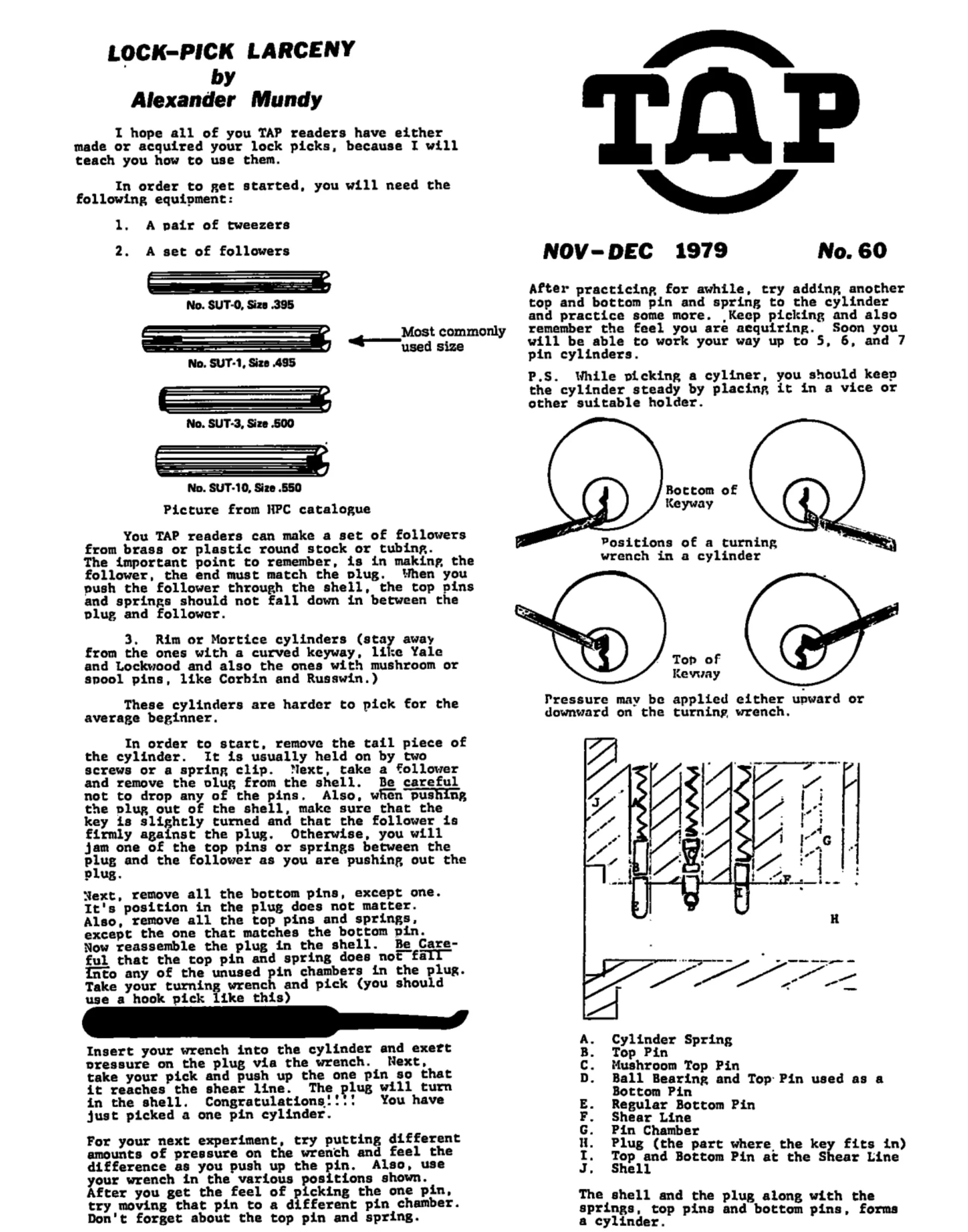
A detailed how-to column by ‘Alexander Mundy’ on lock picking, covering the tools needed (tension wrenches, tweezers, a set of ‘followers’ sized to match plug diameters), how to fabricate followers from brass or plastic stock, and which cylinder types are easiest for beginners versus harder security pins like Corbin and Russwin’s mushroom/spool pins. Walks through disassembling a cylinder to practice on, then building up skill from simple 4-pin cylinders to more complex 5-, 6-, and 7-pin designs, with a tip to mount the cylinder in a vise while practicing.
LOCK-PICK LARCENY
by
Alexander Mundy
I hope all of you TAP readers have either
made or acquired your lock picks, because I will
teach you how to use them.
In order to get started, you will need the
following equipment:
1.
A pair of tweezers
2. A set of followers
No. SUT-0, Size 395
Most commonly
a
No, SUT-1, Size 495
_
No. SUT-3, Size .600
No. SUT-10, Size .550
Picture from HPC catalogue
You TAP readers can make a set of followers
from brass or plastic round stock or tubing.
The important point to remember, is in making, the
follower, the end must match the plug. When you
push the follower through the shell, the top pins
and springs should not fall down in between the
plug and follower.
3. Rim or Mortice cylinders (stay away
from the ones with a curved keyway, like Yale
and Lockwood and also the ones with mushroom or
spool pins, like Corbin and Russwin.)
These cylinders are harder to pick for the
average beginner.
In order to start, remove the tail piece of
the cylinder.
It is usually held on by two
screws or a spring clip. ‘lext, take a follower
and remove the vlug from the shell. Be careful
not to drop any of the pins. Also, when pushing
the plug out of the shell, make sure that the
key is slightly turned and that the follower is
firmly against the plug. Otherwise, you will
jam one of the top pins or springs between the
Plug and the follower as you are pushing out the
plug.
Next, remove all the bottom pins, except one.
It's position in the plug does not matter.
Also, remove all the top pins and springs,
except the one that matches the bottom pin.
Now reassemble the plug in the shell. Be Care-
ful that the top pin and spring does not fa
Into any of the unused pin chambers in the plug.
Take your turning wrench and pick (you should
use a hook pick like this)
Insert your wrench into the cylinder and exert
pressure on the plug via the wrench. Next,
take your pick and push up the one pin so that
it reaches the shear line. The plug will turn
in the shell.
Congratulations
You have
just picked a one pin cylinder
For your next experiment, try putting different
amounts of pressure on the wrench and feel the
difference as you push up the pin. Also, use
your wrench in the various positions shown.
After you get the feel of picking the one pin,
try moving that pin to a different pin chamber.
Don't forget about the top pin and spring.
=~
i
NOV-DEC 1979
No. 60
After practicing for awhile, try addin another
top and bottom pin and spring to the cylinder
and practice some more. ,Keep picking and also
remember the feel you are acquiring. Soon you
will be able to work your way up to 5, 6, and 7
pin cylinders.
P.S. While picking a cyliner, you should keep
the cylinder steady by placing it in a vice or
other suitable holder.
Bottom of
Keyway
Positions of a turning
=
wrench in a cylinder
Top of
Kevway
Pressure may be applied either upward or
downward on the turning, wrench.
Cylinder Spring
Top Pin
Mushroom Top Pin
Ball Bearing and Top Pin used as a
Bottom Pin
Regular Bottom Pin
Shear Line
Pin Chamber
Plug (the part where the key fits in)
ep yne Bottom Pin at the Shear Line
:
e
GHmaAmm oaw>
The shell and the plug along with the
springs, top pins and bottom pins, forms
a cylinder.
Well, well, well, here we are again, folks, with
our never ending blast against technological ignor-
ance, First, congrats to those who sent me letters.
T- only received 5 letters from four different people,
and I could only answer two, but the information I
received was both highly interesting and quite
valuable. So read on...
There 1s indeed a separate military phone system
(see Fut:
Deve:
nts in Telecommunications by
James Martin. Sgt ‘by Prentice-Hall, SpssTe3s, A
ook by Martin,and also Adrian R.D. Norman, that
sounds interesting is The Gonputerized Society.).
It 4s called AUTOVON, which 6
8
for ‘UTosatic
VOice Network. (see TAP,#40, p.2) According to Kr.
Martin, the letters Q and Z are associated with the
1 button as A,B and C go with 2, and so on. Also,
"the called party receives a special ‘precedence’
ringing signal. A unique tome informs telephone
users when they are being interrupted by a higher
precedence call. If one of these keys is used on a
telephone not authorized to use that level of prece-
dence, a prerecorded voice (what rank?) tells the
caller that, such a call cannot be put through." A
California reader (we'll call him "C") wrote "When
used--Press "priority" button first, then rest of
number. Auto selectors first hunts for an open line--
if none open then person using number is bumped (gets
deep signal) only if he is not using a higher priority!
Now that you know generally how to wse the military
tones, you will need to know how to matrix them. A
civilian 7.1. pad and L.D. (Bell Long Lines Dept.
. Long Distance) tones are shown matrixed here.
Low
697
1
2
3
A
Tones
70
4
5
6
5
(iz)
gs2 78k
941
*
oF
#
OD
civitian
1209 1336 1477 1633
Touch Tones
High Tones (H2.)
low
700
4
2
4
7
148
Tones 900
3
5
8B
12
1100
6
9
XP
1300
10.
KPa2
1500
st
900 1100 1300 1500 1700
High Tones (Bell Long Dist.)
The trick to matrixing is to write down the freq.'s
of the low tones, in order, and then the high tones.
Fill in your digits, and you've got your matrix. This
info, and the following, is presented courtesy of an
Aldergrove, B.C. TAPper. He sent me photocopies cf
pgs. 2-13 and 2-14 of a book called Reference Data
"For Radio Engineers. It is apparently available
from Howard Sans.
Also, we'd
like to know what 11 and 12 are used for. The page
I have just says "for inward operators". Page 3 of
TAP #27 has a letter signed "-KANSAS-" that refers
to long distance (L.D. for short) coin collect and
return tones, supposedly 700+1700 and 1100+1700, re-
spectively, and also a "BV key" on some operator
boards. I think that 110041700 must be a typo, since
that is regular KP. .The MF tones for 11 and 12 aré
70041700 and 90041700, reepectively. My Nov. 1960
BSTJ
(p. 1432)
saye that “Assistance operators
handling European international ... calls are ...
"Code 11” or "Code 12" ops, These ops are called
in by transmission of distictive signals ..._
A "Code 11" op is an assistance op who performs the
usual functions of an incoming op in manual service.
A "Code 12" op is a delayed-ticketing or suspended-
call op. When a particular "Code 12" op is desired
@ call number is added and follows the "Code 12"
signal."(T.Vail's abbreviations)
|
Until someone figures out, though,
Military touch tones:
thi
8
"The
here are the
reader also says:
arny numerical
High
Grow
so TAG IBSO TSE
-«=scode ie similar to
1020
4
2
3
Fo
the long
distance
é
oF
codes.
However, this
140004
~=«5
in itself is not
1260
7
8
9
I
enough to suggest
0
>
that the militery
1380
have their own long
Tow
Air Force 412 L
distence eystent
Grou)
2.V¥.
Note-They
do,
Pp
though-AUTOVON
"Concerning similarity: notice how similar they
are when written in a matrix,
High Grou;
B00 2300 2500 2700
Yor regular Bell
code, look else-
190 4
8
0
3
where in this
Group 2400
1
7
8
article.
2300
2
6
2500
5
"U.S. Army TA-341/PP Numerical Code"
"The army code seems to lack the
for KP and ST signals.
"N.B. The blue box of issue #26 can be used for
the army tones. Just re-tune the oscillators (700
to 1900, 900 to 2100, etc.) and relabel the keys (1
becomes 4, 2 becomes 8, etc.).
"I have no ideas on how to use either the air
force or army tones. For all I know, the army tones
might not even be in use." Thank you very much, TAP-
per from Aldergrove.
I, Ted Vail, don't know how one would nse the
military tones without being directly connected to
the military network (AUTOVON), If you were, such as
if you strolled over to a phone during a visit/tour
to a military base, follow the instructions outlined
above by "C", I have a strong suspicion that there is
indeed a connection between the military and civilian
phone systems, Re-read Kilgore Trout's excellent
Re
+ From End Of The Earth", TAP #37,
p.1. He says
ther ithe military makes thet)
ary makes
their own Blue
Boxes" (So
does Bell--a Blue Box is just an imitation of regular
U.D. dialing equdpment]!! They are, I presume, for
calling into the civilian system. Kilgore wants to
set up a phreak connection between the civ. and mil.
systems up there. Hopefully, one wouldn't have to go
through a human operator; we're not all good at BSing.
NOTE: Kilgore, or anyone else who knows anything
about these things, please write me at TAP, Ted Vail,
Room 418, 152 W. 42nd St, New York, N.Y. 10036.
A number of people think that the special
frequency for the military override buttons is 1633
Hz., the fourth column frequency for the civilian T.T.
pads. I politely point out "NO!
Civilian phones are
used only on the regular Bell system, with the A,B,C,
D,*, and # buttons used for computer access or quick
dialing (some executives have this--they just push,
say, the * button and their home number, or other
predetermined number is immediately dialed). The
special priority tome must be extra on a military
phones namely, 1980 Hz (mixed with the appropriate
tone). Regarding SF: Flash Bazbo of Iowa (note-- when
writing me, include a code name so I can refer to
you directly without exposing your initials. It's
flattering to see your name (alias) in vrint!)sent me
the following letter:
fed: According to the information I have (1960
Bell System Tech. Journal), SP signaling was used
for “exchange applications". The following quote is
straight from the horse's ass, so to speak!
"For application in the exchange plant, a new
series of transistorized signaling units makes it
possible to adapt
ing
trunks (all under-
lines are Flash's)
to shor’
carrier systems. The
SF units provide loop-signaling--reverse-battery
supervision toward central office switching equip-
ment, and in-band AC signaling toward the line.
These units also include the 4-wire terminating sets
required for converting between the 4-wire line
facility and the 2-wire loop. The terminating sets
are suitable from a transmission standpoint for ex-
change, tandem and .toll-connecting trunks.
"The originating
terminal Tnetudes 2 recieving
circuits: one a 2600
Hz. receiver, to detect trunk
status signals, the other a
Hz, receiver to
detect the revertive
ses.
ie terminating end
of the trunk only a
2600 Hz. receiver is required to
détect trunk control signals, but 2 transmitters are
provided: the revertive pulses are transmitted by
oscillator, while the trunk status
extra tone needed
the
2000 channel for the re-
vertive pulses is quite wide in order to accomodate
the high-speed signals. As indicated, pulsing speeds
of up
to
32/sec. are used
low!
ce
you will--the SF "keyer" is refer-
red to as a "loop signaling trunk". If there are any
of these old fashioned senders in existence (knowing
Pa Bell they must bet) it should be possible to build
just a 2000 & a
jz. oscillator, put the 2000 on
a@ normally open dial contact & let your phingers do
the walking! To speed things up a bit, aljuse the
dial governor so it puts out more pulses/sec. I am
currently constructing one to phool around with in a
dial trimline I "borrowed" from a local phone store.
I will inform TAP readers of the outcome at a later
date.
I also understand (same Bell-bull) that a 3700 He.
tone can be interrupted at dial speed to send you
phar, phar away. It was called SF out-of-band and the
equipment was "types N,O,& ON". Any reader supplied
info would be greatly appreciated. 2600, FLASH BAZBO
Thank you very much, "Flash",
You would probably be able to go all over the world
with this sort of beeper, since even an antiquated ex-
change has a modern dual-freq. "blue box" for communi-
cating with other exchanges. The old exch. would
receive your old-style beeps and convert them to the
newfangled DF for re-transmission to the rest of the
world. Kilgore Trout (iss. 37, p.1, column 1 at bottom) outdoor coin phone. If one wants to split the
discovered SF independently (I guess). Again, anyone
who knows about this; please write, as usual.
On the back page
of #37 was an article by Tom
called Bell's Boxin' Us In, in which Tom described
another black cloud on the phreak horizon, namely
C.C.1.S., which is Blue Box proof. The ESS long dist.
exchanges used for CCIS stop Black Boxes, too, since
they don't connect the audio until the receiving end
definitely answers, at which time the ESS sends the
initiating end (which 1s doing the billing) a
definite "receiving party answered" signal. What a
hassle! Does anyone know how to defeat this?
I would like to know how Bell's new Blue Box
detector/tracer is used, and how it works. The news
clip on p.1 of iss. 46 is a bit hazy on the technical
end; phrases like "protective electronic fog" sound
nice to the general public but are electronically
meaningless (perhaps deliberately?). The thing that's
real.
scary about this gadget, assuming it's not a
hoax
(I don't think it is), is that it can trace right
back to the phone on which the Box is being used,
within seconds!
t mig)
e possible to determine what kind of
equipment your local Telco has by looking at the
little notations in the lower corners of coin phone
dialing instruction cards. However, one would need
access to some internal Western Elec. info to
"decode" the meanings . To any of you who work for
Bell and know how this works, deciphering should be
easy. Two inst. cards I saw recently said "ISPS
PRE 0-555" and the other said "PRE/POST 0". Rather
than hazard a guess or two right now, I'll wait for
some reader response on thes and together we'll figure
it out. I would also appreciate some details on TSPS
(what it is and does). And while we're on this, I'd
also like info on IOTC.
Please do not include subscription orders or other
TAP business with your letters to me. I am not in
New York very bften, so the mail is forwarded to
me. If an order and a letter to me are on the same
page, that sheet stays in New York and I never see
it. This happened to a reader from the Uhicago
(4.0.312) area--and I don't know his name or address
because that, and his order, and the rest of his
letter were shredded in NYC before I saw them. If
that reader would like to write again...? The
-
letter was written with a black felt tip pen on
the back of some math problem ditto sheets, 80
the writer was probably an ‘elementary school
teacher, but that's all I know about hin (her?).
Several readers would like to know how to get the
Abbie Hoffman books other than Steal. According to
Bowker's Books in Print Index, Revolution For the Hell
of It is available for $1.25 from Pocket Books, 630
Pifth Ave. New York City
10020. Puck the System is a
phlet included in the back of R.
for the
He:
I have seen Woodstock Nation, and
fon't
think muc!
of it. A Northern Ill. reader sent me some info that
other Illinoisans might enjoy:
Skokie, Il1., the world's largest
village (over 50,000 pop.), has an excellent library,
which contains all of Abbie's books, and a copy of
the Nov. 1960 Bell System Tech Journal that started
it all. A Skokie bathroom stall contained the follow-
i
affitus:
.
NB BALL THE WORLD'S A STAGE, SO LET'S ROB IT",
Signed, JESSE JAMES
Appropriate? Hmmm...
There's also a #, (312) 796-9600, that can be called
to find out the name and address that correspond
with any given tel. nr. Just give them the nr.
and they'll give you the info you want. That’
(512) 796-9600. Neat!
As far as petty theft goes, those TAPpers interested
in free drinks (and glasses!) might be interested in |
this: At "Red Lobster" restaurants, you take a
numbered ticket at the door which you exchange for
drinks, The bar tender gives you a bill with the
amount on it, which you give to the waitress. The idea
is that you don't pay ‘till you leave after eating,
so if you leave in apparent disgust, empty-handed,
nothing is suspected.
Moving on to telephones, I have two ideas to share.
First, TAPpers living in colder northern climes can
get a roll of ducttape, a torch, a funnel with the
end flattened, and a container or two holding 2 gal.
of fresh water and drive on a very cold night to an
hone
wide open, one needs only to tape up the phone!
holes, seams and cracks, and pour the water in, fill-
ing up the phone to the ton. After an hour or less,
depending on the temp., the ice's expansion will
shatter the housing's brittle cast iron. Thawing with
the torch should remove the pieces. Careful melting
will expose the back bolts, allowing the nefarious
perpetrator to cart the pieces, plate and all back
home.(Four water through funnel intocoin slot)
Once this hypothetical character gets it all
unfrozen, he removes the locks, remembering which
went into the upper housing and which the lower.
He knows that the lowers (coin boxes) are individual},
keyed, and he also knows that the uppers (electronics}
are all keyed the same, according to region; that is,
the Upper: housings in one region are the same.
There are 3 diff. ones for N.Y.City, because that is
80 populous, He takes the upper lock to a competent,
cool locksmith to get a key made for it. Bell probably
has a special, private blank, but others may fit into
the keyway. In desperation, a piece of sheet metal
can be bent into the zig-zag pattern and cut into a
key. The local locksmith had better be very cool, or
he'll suspect that the lock is a special, industrial
high-security lock which common people aren't
supposed to have.(True enough.) But a determined
person could eventually have a key to all the coin
phones in his/her area. Of course, the coin boxes
couldn't be opened with the key, but since all but
4 weak bolts can be removed easily with the upper
housing off, and the rest can be pried/levered out,
this isn't a biz problem, That's enough for now,
And, lastly, for ail those who care, I nave round
what TASI 1s. In Fa's own words,"A YASI system
jsigns a speech channel to a talker only when a
channel is required, and when a channel is not
required it is prepared to ewitch that channel to
another talker requiring a channel." This is why
the beginnings of words are often cut off during
a long dist. conversation. Finished 9 August '78.
dith these thoughts I leave you,...TED VAIL
‘TAP has sold out of "Ma Bell Is A Cheap Mother" T-shirts,
Please do not order them anymore. We still have a quantity
of TAP T-shirts in stock,
Back Issues are 50f each. Issue
#50 ts $1.00,
‘Budscriptions
- 19 tasues - US Bulk rate $6,
US First Class in plain sealed envelope $7.
Canada
& Mexico First Class $7,
Foreign $8.
Include mailing Inbal oF Xerox copy
when writing to TAP about your subscription,
= SOfeach, A - DC Basics,
B- AC Basics, C- Phone Basics, D- Amplifiers.
TAB Moas - $4.50.
IAP Teshicts ~ $4, 60, Specity
size and color : Small,
Mediam, Larye, Extra Largo, Black or red T-sbirt
‘with white TAP logo,
‘TAR "Cracked Bel!" Button 50° each,
TAB Casseue
‘Tape =
$3.50. Hear Capt Crunch, Al Bell,
Joe Engressia, and Bell Security Chet John Doherty.
TAR "The Teleshcne, #3" artist print - $3.50. M2unting
Tostructions far Bax concestment included,
TAP "Ma Bell is A Chesp Mother etch - $1. 50.
1s
Sot
(y
<
Xa
<
4
OTe
TAP is published bi-monthly for informational purposes
only by Youth Hot Line Reports, Inc. Address al mail to:
TAP, Room 603, 147 W. 428t., New York, N.Y. 10038,
TANDEM TRICKS by Napoleon Solo
To stack world tandems you will need:
1. A 750 Hz oscillator - the Touch Tone 770 Hz will do.
2, A 228) Hz oscillator.
In order to use the Single Frequency or SF 77) Hz tone,
simply depress the #4 & 5 push buttons of a standard Bell
‘Touch Tone pad simultaneously. Now let's call ourselves
around the world and stack a few tandems in the process:
1. Get on Cakland (Ca) 415-186.
2, Dial Australia - 61 + 3 - This puts you into Melbourne.
+ 153 - This puts you into Sidney.
+81 - This puts you into the overseas sender.
+ST - This finishes the MF part of the call. Now you can
throw your Blue Box out the window!
3. SF 750 - 991 - Equivalent to KP-2
+ 44 - Country code for England.
+2 - Language digit.
+ 421728 - This puts you back into the London overseas
sender,
+ ST
- To send ST you hold down the 750 Hz tone for one
second. Once this one second burst of 750 Hz occurs,
any other burst of 750 Hz won't interfere with this
call.
4, SF 2280 - 61 + 3 - This puts you back into Melbourne
(Your second time around!).
+153 - This puts your tired finger back into Sidney.
+81 - Back out to, .. (Goodness knows where!). Let's
call'the U.S. of Amerika.
5. SF 750 - 991 - Equivalent to KP-2.
+1-U.S, country code.
+2 - Language digit.
+ AC - Area code,
+No. - Number (Your other line).
+ ST - Start - Again the one second burst of 750 Hz.
Note: You can't go back to England again because you will
Screw up the first England part of the call with 2280 Hz.
NOW!11 IF you haven't screwed up, IF you haven't gotten
busted, IF you put 200 watts of audio down your line, IF
none of the circuits were busy, IF your other phone wasn't
left off the hook so it will be able to ring, IF you dialed the
correct numbers, IF when you pick up the phone and IF it
isn't a friend calling or IF it isn't the FBI, CIA, or Bell
Security calling, you will hear a soft hiss and after what
seems like an eternity, you will hear a bizarre series of
weird tones. Don't be alarmed, it's only the supervision
‘Signal on its way to make that "nasty" little "tick" on your
ticker tape. It will take quite a while. When all the gleeps,
gloops, glitches, peeps, poops, and grunts are over, you
have just gurdled the globe! With your cute little Princess
Phone say hello into one phone and listen to the other. With
@ stop-watch measure the time it takes. If you are lucky,
you will hear some talking. It will be you!!! 25,000 miles
away! Really far out! (with apologies to John Denver.)
Be sure to hang up the phone you called from because the
best is yet to come. Listen to the "hang-up". It really takes
a long time and is real "gone"! By the way, don't
be too
Surprised if after the 100th try it works, It will take about.
that long. You have everything in the world against you and
only one thing for you and that's patience. But WOWI!1 The
feeling of success when you do it is really a gas! It makes you
feel like you just ruled the world! You did - at least the-
world tandems! And don't forget to go out and get the Blue
Box you threw out the window!
“Helle, This ta the
‘tmechanteal answering
device attached to the
number you dialed.
‘When you hear the
tone, please give your
aumber, identity and
reasan for calli
& Later date, G
Help Stamp Out Lotters
10 MANY people find ft hard to
‘rasp the reason for the new
IScent price of a firstelass
stamp that I want to break
down the eost in easy-to-understand
Of that 15 cents, 28 cents goes to
Geltvering
the mail tate. Years ago,
‘when mail was simply delivered
an time,
Lt cost the post office almost acthing.
‘Today, however, with the high price of
Getalning a letier, the cost bas skyrock-
FREY
H
Understatt, chiet of the Post-
special mail-mangling
plains: “In the old days, we
ir
i
/
1
delivery, but now al
compa ne,
a
the came time ax rugeteaning elreu-
“Converting to slower special deliv.
ery was
quite expensive.” eald Under.
‘aueh mall arrives
ig that the purpose
Is to
St foare
people to ute “alr express.”
‘whieh cor
iF letter there
Bs alekdy especial ellrery used
T asked him how he managed to slow
down special
‘he sald it had meant buying a lot of old
livery 20 effictently, and
far I
biplanes,
but even that
Ira ies
tte
e
fo
more. peapi
fosing equipment, which has replaced pains
of 500
He, ceeutional
lezy. oF eraay portman
“ris postal official continued: “We're
cramer tin gt Drecrnces
ces
By neighborhood children piaying hide
O°%4'to the post effice. by eking ry
.
Doky and exorbitant
that the public will
Of the 18 cents, sal6 Undersiaft,
L& be discouraged
from writing ietters If
cents goes into fewer mall box
Deople
persist la sending letters indi.
af day. Ws very ceslly, he
rm
tag yeu that plekap thnes have Been
a8
iH
it
H
Hy
U.S. BSPARTMENT
‘up another dollar
s quart,” seid
W. C Flels aver 0 long ago.
(Nothing has changed, Mr. Fields)
'T:
COST OF LIVING has gone
TAP
Room 603
147 W. 42 St.
New York 10036
60
GP GUREAUS —" FILLING Our THOSE
_ CERTAINLY
1. JUST
‘You NeED HELP
FEDERAL FoRMsS>
FILL OUT THis
FEDERAL AssispANcE
Reoutsr FoRm.