
January 1, 1980 · TAP
TAP No. 61 - 1979 Year in Review, Better Living Through Chemistry
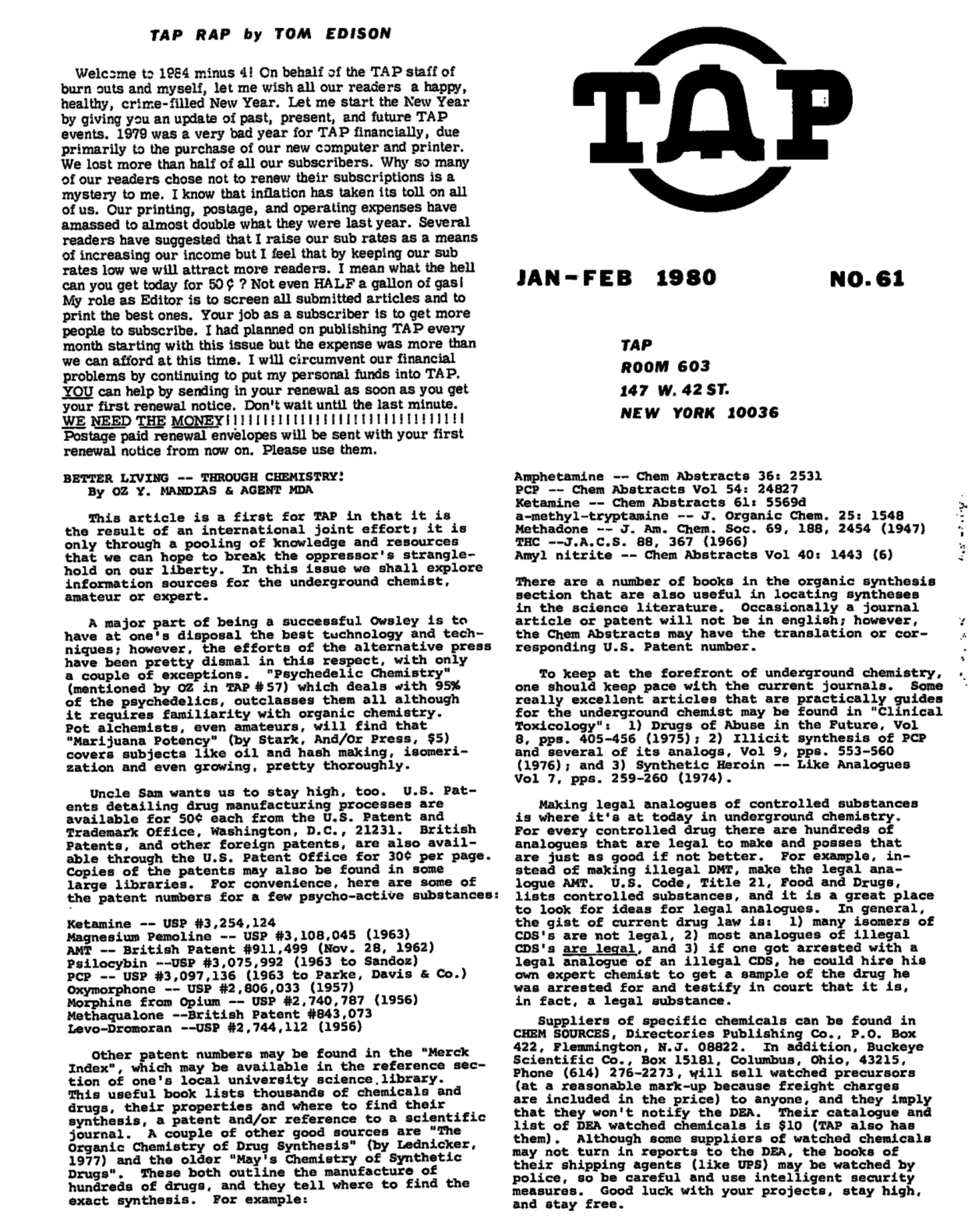
Editor Tom Edison opens with a New Year recap describing 1979 as financially rough for TAP, largely due to new computer/printer equipment costs and a steep drop in renewing subscribers, and asks readers to renew promptly rather than raise rates. The featured article, ‘Better Living Through Chemistry’ by Oz Y. Mandias and ‘Agent MDA,’ is a research guide for underground chemists pointing to Chemical Abstracts citations, U.S. and foreign patent numbers, and specialty journals as sources for drug-synthesis literature, and discusses the strategy of making ’legal analogue’ compounds not yet named in controlled-substance schedules.
TAP RAP by TOM EDISON
Welcsme t2 1984 minus 4! On behalf of the TAP staff of
burn outs and myself, let me wish all our readers a happy,
healthy, crime-filled New Year. Let me start the New Year
by giving you an update of past, present, and future TAP
events. 1979 was a very bad year for TAP financially, due
primarily to the purchase of our new computer and printer.
We lost more than half of all our subscribers. Why so many
of our readers chose not to renew their subscriptions is a
mystery to me. I know that inflation has taken its toll on all
ofus. Our printing, postage, and operating expenses have
amassed to almost double what they were last year. Several
readers have suggested that I raise our sub rates as a means
of increasing our income but I feel that by keeping our sub
rates low we will attract more readers. I mean what the hell
can you get today for 50¢ ? Not even HALF
a gallon of gasi
My role as Editor is to screen all submitted articles and to
print the best ones. Your job as a subscriber is to get more
people to subscribe. I had planned on publishing TAP every
month starting with this issue but the expense was more than
we can afford at this time. I will circumvent our financial
problems by continuing to put my personal funds into TAP.
YOU can help by sending in your renewal as soon as you get
your first renewal notice. Don't wait until the last minute.
WE NEED THE MONEYIIHITEIEIDEEEEUPE
TELE T
‘Postage paid renewal envelopes will be sent with your first
renewal notice from now on, Please use them.
BETIER LIVING -- THROUGH CHEMISTRY:
By OZ ¥. MANDIAS & AGENT MDA
This article is a first for TAP in that it is
the result of an international joint effort; it is
only through a pooling of knowledge and resources
that we can hope to break the oppressor's strangle-
hold on our liberty. In this issue we shall explore
information sources for the underground chemist,
amateur or expert.
A major part of being a successful Owsley is to
have at one's disposal the best technology and tech-
niques; however, the efforts of the alternative press
have been pretty dismal in this respect, with only
a couple of exceptions. "Psychedelic Chemistry"
(mentioned by 0Z in TAP #57) which deals with 95%
of the psychedelics, outclasses them all although
it requires familiarity with organic chemistry.
Pot alchemists, even amateurs, will find that
“Marijuana Potency” (by Stark, And/or Press, $5)
covers subjects like oil and hash making, isomeri-
zation and even growing, pretty thoroughly.
Uncle Sam wants us to stay high, too. U.S. Pat-
ents detailing drug manufacturing processes are
available for 50¢ each from the U.S. Patent and
Trademark Office, Washington, D.C.,
21231. British
Patents, and other foreign patents, are also avail-
able through the U.S. Patent Office for 30¢ per page.
Copies of the patents may also be found in some
large libraries. For convenience, here are some of
the patent numbers for a few psycho-active substanc:
Ketamine -- USP #3,254,124
Magnesium Pemoline -- USP #3,108,045 (1963)
AMT -- British Patent #911,499 (Nov. 28, 1962)
Psilocybin --USP #3,075,992 (1963 to Sandoz)
Pop US? #3097, 136 {1963 to Parke, Davis & Co.)
one -- USP #2,806,033
(1957,
Morphine from Opium -- USP #2,740,787 (1956)
Methaqualone --British Patent #843,073
Levo-Dromoran --USP #2,744,112 (1956)
Other patent numbers may be found in the “Merck
Index", which may be available in the reference sec-
tion of one's local university science, library.
This useful book lists thousands of chemicale and
drugs, their properties and where to find their
__
synthesis, a patent and/or reference to a scientific
journal.
‘A couple of other good sources are “The
Organic Chemistry of Drug Synthesis" (by Lednicker,
1977) and the older “May's Chemistry of Synthetic
Drugs". ‘These both outline the manufacture of
hundreds of drugs, and they tell where to find the
exact synthesis. For example:
=~
wT
JAN-FEB 1980
NO.61
TAP
ROOM 603
147 W. 42ST.
NEW YORK 10036
Amphetamine -- Chem Abstracts 36: 2532
PCP -- Chem Abstracts Vol 54: 24827
Ketamine -- Chem Abstracts 61: 55694
a-methyl-tryptamine -- J. Organic Chem. 25: 1548
Methadone ~- J. Am. Chem. Soc. 69, 188, 2454 (1947)
THC --J.A.C.S. 88, 367 (1966)
Amyl nitrite -- Chem Abstracts Vol 40: 1443 (6)
There are a number of books in the organic synthesis
section that are also useful in locating syntheses
in the science literature. Occasionally a journal
article or patent will not be in english; however,
the Chem Abstracts may have the translation or cor-
responding U.S. Patent number.
To keep at the forefront of underground chemistry,
ene should keep pace with the current journals. Some
really excellent articles that are practically guides
for the underground chemist may be found in "Clinical
Toxicology": 1) Drugs of Abuse in the Future, Vol
8, pps. 405-456 (1975); 2) Illicit synthesis of PCP
and several of its analogs, Vol 9, pps. 553-560
(1976); and 3) Synthetic Heroin -- Like Analogues
Vol 7, pps. 259-260 (1974).
Making legal analogues of controlled substances
is where it's at today in underground chemistry.
For every controlled drug there are hundreds of
analogues that are legal to make and posses that
are just as good if not better. For example, in-
stead of making illegal DMT, make the legal ana-
logue AMT. U.S. Code, Title 21, Food and Drugs,
lists controlled substances, and it is a great place
to look for ideas for legal analogues. In general,
the gist of current drug law is:
1) many isomers of
CDS's are not legal, 2) most analogues of illegal
DS's are legal, and 3) if one got arrested with a
legal analogue of an illegal CDS, he could hire his
own expert chemist to get a sample of the drug he
was arrested for and testify in court that it is,
in fact, a legal substance.
Suppliers of specific chemicals can be found in
CHEM SOURCES, Directories Publishing Co., P.O. Box
422, Flemmington, N.J. 08822. In addition, Buckeye
Scientific Co., Box 15181, Columbus, Ohio, 43215,
Phone (614) 276-2273, will sell watched precursors
{at a reasonable mark-up because freight charges
are included in the price) to anyone, and they imply
that they won't notify the DEA. ‘Their catalogue and
list of DEA watched chemicals is $10 (TAP also has
them). Although some suppliers of watched chemicals
may not turn in reports to the DEA, the books of
their shipping agents (like UPS) may be watched by
police, so be careful and use intelligent security
measures. Good luck with your projects, stay high,
and stay fre
Computing for the Masses:
A Devious Approach
by A. Ben Dump
With all the
timesharing computers around
today, there is a lot of computing power going to
waste. Most of you know a good deal about the
fone
gystem and since the fone system is the means
for computer communication, there is the potential
for much accomplishment.
It's your American duty
to go out and consume some of this awesome amount
of unused computer time since nobody wants to pool
it as-a computer utility and make it available to
everyone because it would probably aot make a
profit.
This
information is
provided
for
informational and educational purposes only since
the Feds have made it a major crime (like 5 years
and $10,000 dollars or more)
to fuck in ANY way
with any government computer.
They are trying to
extend this to all computers (to the tune of 15
years and $50,000) since the government contracts
a
lot of
sensitive
work to
universities,
manufacturers, and think-tanks.
Getting into
corporate computers can be hairy since they think
you're after their trade secrets(who cares?).
Also, getting into financial computers can also
bring down great shit since people are very touchy
about money. Part one of this article talks about
how to
get access
to a
computer;
part
two goes
into what techniques to use once you're on a
system,
Part one is mainly common sense and
phreaking skills applied to computers.
Part two
gets into some heavier computer software shit, so
find a friend who is a real computer hack and go
to it. Thanks to the Magician for constructive
comments and to Mike the computer for lots of
experience.
There are two basic problems to be solved if
you're going to work with computers. The first is
how to gain access; the second is what to do once
you have access.
The assumption is that you have
a number to call the computer.
If not,
you'll
have to apply some fone phreak skills to get a
dialup. Scanning around the main fone number of
of companies that might have timesharing computers
can be interesting. Also, you could try calling a
timesharing company and asking for the dialup
claiming that you forgot the number. The Bull
System has its own share of computers which you
might find while scanning for other things. See
TAP Issue 50 for information on tandem scanning.
If you really want to get into the fone aspects of
computers, find out more about computer networks
like Telenet and Tymnet.
I think National CSS has
their own
computer network.
These networks
usually have a dialup in a large city (over 50,000
say) or a place where there are lots of users.
Some computer centers are also providing 800
numbers to their network rather than local dialups
in each city.
The easiest method of access is to be a
legitimate user. For those of you who think this
is no fun, please skip to the next section.
If
‘re a student ct a university or live near one,
it's sometimes possible to get a complementary
computer account or to give some bullshit about a
special project and get an account under a phony
name. The word ‘account! as used here means both
patch account numbers and timesharing userids.
Batch
account numbers
can
be
useful
when
submitting jobs from timesharing or for doing
terrible things when you don't want to be caught a
sitting duck. Class account numbers (meant to be
used for course work) are no good unless you share
it with a bunch of other people.
If none of this is possible, then you'll have
to do a
little footwork.
Check out a university
computer center or terminal
toom for output
tings or card decks which aren't being watched.
The qarbage from small or medium sized computer
companies is another possibility, though a lot of
them have paper shredders now. Some people are
determined enough that they will search through
the shreds to piece together a
userid and a
password. Inga terminal room,
the key is to keep
your eyes and ears open.
Look over shoulders
discreetly and watch for people who dial 800
numbers or other numbers with too many digits.
Clieck out people whose terminal is still working
when the system that everybody is supposed to be
using is down. It's not good to keep trying to
access the system if you don't have the correct
password or any idea what-it might be.
If you
know who owns the userid, try guessing at various
things
(phone number, girlfriend's name, other
dumb shit). Even the shittiest system will put a
message to the system log or the operator's
console
about
an
illegal
access
attempt.
Hardwired terminals sometimes have key or magnetic
stripe access and no password scheme.
Key locks
can be picked and an existing magnetic stripe
could be "developed"(make visible the code on the
stripe) anda new, bogus stripe made up.
You
could also use your trusty Blue Box to autoverify
the computer dialup and “piggyback” the line with
your terminal or computer in order to record the
userid and the password.
Sometimes the phones in
terminal
rooms
are
toll-restricted
or
centrex-restricted which can make calling other
computers more difficult.
Hiding the origin of
your call within the great Bull System is good to
do if you want to scan for passwords.
All systems have some sort of supervisor or
privileged state for userids. On some systems, if
you know the right command, any userid can become
privileged. on others, you still need to know the
magic command,
but execution
of that
command is
limited to just a few userids. The most secure
system is where only the operator in the machine
room has privilege or only certain userids are
generated into the system as privileged or you can
only use privilege from a hardwire terminal.
In
some systems, there is one userid generated into
the system when it comes from the manufacturer.
Some installations don't bother to change this
userid or its password EVER. One APL system has
the main operator id
(almost always 314159)
without a password. They're just hoping that the
dialups are disabled whenever the operator is not
logged on.
Once you have privilege, it's possible
to take and maintain total control of the system
until either the operator gets upset and takes the
system down or until
someone with privilege
manages to logon despite your efforts.
If you get
a privileged userid, look for an online operator's
quide
for information
about special
system
functions and features.
Check out some of the
programs on the userid and list out any files that
seen interesting,
Names like SHUTDOWN, FORCE,
ENABLE, DISABLE,
etc. are the types of commands
that operators use.
Sometime you can use
a
privileged userid to create a new userid for
yourself (maybe even with privilege). Try and get
the manufacturer's operator manual and/or the
system programmer manual for the system that
you're using. This can be difficult since the
most useful information is usually restricted.
Program logic manuals are not very useful unless
you know exactly what you are looking for.
What do you do if you get forced off the system
or you get a
message asking you to call the
computer center? Well, do it.
Bullshit as usual.
Knowing who you are supposed to be can be very
important here.
Look at the files and programs on
the userid that you're using and try to find out
who the owner is and what he does.
If they want
to call you to verify that you are real by calling
you back, have them call
a looparound with you on
the other side. Remember, computer operators are
not always the brightest folks
(having been a
computer operator, I've seen some
real winners).
on off-shift (after 6 PM), there is usually nobody
for them to check with on what to do.
On most
systems, there is not much that an operator can do
to disable a userid or otherwise do anything about
an illegal access.
Success at computing depends quite a bit on
what kind of software the system uses. There are
so many different systems that it is impossible to
qive any hard and fast rules on what to do.
Some
systems tell you when you've committed a security
violation, others don't. Some systems drop the
fone line after three or five unsuccessful logon
attempts. Newer products tend to be more reliable
and secure than old software, but there is a
h@lluva LOT of old, rinky-dink software around.
Most systems have some sort of news or HELP file
with all sorts of great info about the system.
Sometimes responding with a question mark to an
error will get more info about the mistake. Look
for listings of additional dialups and other
system information while youtve got the chance.
The kind of terminal that you use can help the
effort a lot. You must be able to select several
different data rates.
110 and 300 bits per
second (bps) are the most common although some do
have 600 and 1200 bps dialups. Most computers
talk in ASCII except for IBM machines which talk
in EBCDIC.
IBM also
uses a different data
rate(134.5 bps)
for its
low speed terminals
(2740's, 2741's). Some systems are smart enough to
figure out what speed and what character code your
terminal
uses.
CRT
terminals are
best
for
something terrible that you want to do quick and
have no record of but for most work, you'll want
to use a hardcopy terminal so you'll have some
reference material.
I recommend the TI Silent 700
and its
relatives or the Intertec
SUPERTERM.
As
we will see later, a paper tape reader/punch can
be handy also.
Recommend reading is Digital
Aspects of Data Communication by John E. McNamara
and published by Digital Press, Maynard, Nass.
This costs
about $20
and is
an excellent
introductory book and also covers many advanced
topics in a clear, consise manner.
You might also
check out books about computer crime so you can
learn from others people successes and mistakes.
The
next
logical
step
from
flexible,
semi-intelligent terminals is to a full-blown
mini/microcomputer.
This is the newest
and most
effective means a gather information on other
computers.
Our first attempt at this was a
proaram which punched a paper tape with the stuff
that
we would have had to type in.
Then we
started the paper tape reader which runs faster
than anyone can type and it doesn't make any
mistakes. We were able to use this method both to
gain access and to do stuff once we were logged
on.
You could also try making a paper tape loop
of something insidious, The infamous computer
‘Charlie! was used to dial 800 numbers and scan
for WATS extenders.
I'm designing a system now
that will automatically scan for computer dialups,
test them for data rate, and possibly even attempt
access.
Having a computer as
an assistant is the
most creative way
to go about this since you can
write a
program to perform almost any manual
function, assuming you have the proper interface
circuits. If you wish to try this, you will need
a modem and a digital/analog(D/A) convertor to
generate Touch Tones or
MF under computer control
plus
an
analog/digital(A/D)
convertor so your
computer can hear what's going on.
Information on
this will be forthcoming in future issues.
More
details on iterative methods via computer will be
discussed further in part two of this article.
LETTERS FROM READERS
Dear T*r,
I would like to thank you for giving me «
forum on which ‘I could express my anger and
hatered for MA BELL. I wes overcharged $25
on my phone bill end was told if T did Not
pey it I would heve my service cut off. Reing
frustrated I decided to pley their geme «nd
pey the $25, Now I was looking for © way to
redeem this money, but not in cash- in aggra-
vation for the phone company. I have been
.
gluing the locks on their fortress pay phones
closed, both top and bottom locks so the only
way thes could get their money out is to remove
the whole booth. I find the best ones to do sre
the ones with high traffic, that way you cxn be
sure that it will be replaced to do it again,
I have been doing about 4 «4 day end the more I
do the better I feel, Please note that no other
damage hes been done to the phone so it can still
be usdd by anyone having to make en emergecy cull.
I hope that all Tap members will give this little
game @ try. REMKVBER, DOING IT Yo MA BELL IS
BETTs#R THAN DOING IT Tu YUUR GIRE FRIEND!
sincerly Yours,
Commander end chief of
the enti MA BELL forces
of New England
BY THE BALLS
by
Nickolai Testicle
When was the last time you used the pay telephone at MacDonald's?
Well, MacDonald's doesn't have pay stations for its customers.
At least they don't here and our suggestion to them, placed
through a member of their staff who presented it to the "brass"
brought the word that "headquarters doesn't allow us to install
public telephones on the premises or in the area". It seems there
was a reported hassle of some sort somewhere and those MacDonald's
that had public telephones had them removed.
In our area a public phone at the burger joint would not only
be a great convenience to me but would also permit me to spend
more money with Ronald MacDonald. As it stands now I must leav=
and go to another shopping center if I want to make a phone call.
The other center has a Burger King,...but I prefer the Big Breakfast
at MacDonald's.
Does MacDonald's have a public telephone where you ave? If not,
lets bombard their local stores, local district headquart
and corporate headquarters (if we can find its address) with
complaints and suggestions that they install at least one pay
phone somewhere near the joint. After all, if I find some nice
worms in my hamburger I might want to call a friend to see if
the fish are biting!
LD calls placed from a third phone and charged to your phone
back home, by dialing § before the called number, are billed
ac operator-assisted calls and cost you just as much as if
you merely dialed # and let the operator do the dialing for
you. Of course your dialing the complete number
saves a lot
of work for Ma Bell's people and a lot of time that could
be better spent making her even richer, Since the call costs
the same cither vay, and tales about as much time to complete,
why don't we start having the operator do the dialing for us?
Maybe if cnoush of us across the
Ma will chan
r policy and give us credit for DDD when
such calls are
handled.
the current practice is discriminato:
Decause 1t is impossible to DDD from a pay station (isn't 4
sreat US of A practice this
Silly Putty. Not all brands work equally well in "picking
up! images. I bought some old stock and it wouldn't work
at all.
"It wasn't silly, it was merely foolish!" I took it
back and got a refund. ‘those who might try a previous suggestion
about picking up typewritten info, etc., with Silly Putty keep
in mind that if it won't work you should get your money back...
unless, of course you just like to play with the stuff,
Nickolai Testicle
PS One or two have requested copies of Don the Ripper's stuff
and due to malfunction of the copy machine at the PO I have
deen unable’ to comply, Have eye on an offset machine and maybe
by time this appears
(if) I will be set up,
Might
even reproduce
in quantity and sell for cost of materials and let the crooked
bastard sue me if
he has the nuts!
Ever beer. in a library, office, or other place, see something
you'd like a copy of, such as a signature, sone figures, a formula,
schematic, phone number, etc? Sure wish you had a miniature copying
machine, didn't you?
‘Silly Putty" to the rescue!
Yep, that child's play gunk is ideal to lift a perfect repro
of almost anything that is printed....even picks up the colors!
Sure, the impression is bassacwards but who cares! If you're not
good at reading backwards just hold it up to a mirror.
Smatterafact, sometimes you can use the Silly Putty to re-stamp
the image onto another plain piece of paper. But I don't take chances
with messing up my original. I read it, copy it off, or if the need
arises, duplicate it on a zerox-type machine.
To destroy the "evidence" after you've read the lifted impression,
just wad the stuff up again and its gone! If you didn't already
know, “Silly Putty” can be used over and over again.
Nickolai Testicle
LEGAL STONES 4
Laughing Gas
by Gz Y. bardias
The laughing gat high ie si:dler to that
but much core vell Anown. Lavghire ges, or ri
is alse rack
Pleesureable to take, rot ki
terrible sell cf cther or the rick of fire.
kewever, herder to obtain arc vore ex:
There is also little lege! rick.
Here are e rw.ter of ways of obteininy "nitroue."
it is used se a propellant fer whipping cree... whet yor
refrizer-
cenn ci
that the
of ether).
rou oxide,
ing the
tis,
ve if bought.
can do is pay a visit ta your leca? su;
etor section ene stand around taxing
vhippicg ereex (check
prorellert
freon ené
the Jebel, thoug!
a nitrous oxide ara
rouse, both of vhick skoule te ex
w nay have problexs trying to ex
re coirg to en irate store >
WAT
F rose full
whieh o
whipped crenu. You can vet a hit er two per
rtunstely only larte for a :inute
er two.
. blue
tenis fra: en inaustrial cumplier. The core ic over 200,
hell of which te a refunéanle cezorit or,
exact procedure cer be f
tal
stry text. ‘ollow
aré be sure rot to heet the ritr
should be le? throwk the jurtficr ant
iagrened below
i
icpurities. Collect the rue in cone cort of teller. or buy,.
If you are conpletely irnorant
chenintry und Lee
equiment, get eoneone who do
he
The equipcent ts rot Lara or exzensive te
y snocable fro: your x0
urther infor.otion
availeble in “Leuphine Sa
Venceremon!
bb
bine ink and
the Beil System logo, resemble company
sire pt
"That certainly doesa‘trefiect the philosophy ofthe telepbone company fp any wa, ‘says PNB
publicity representative Chuck
I, who
that the:
cares. “You bet we care. We
(gperats franchise Inthe public iperin. People can't ext eens
anyone else. You bet we care.
fete:
to find out who's printing them so that we can teil them that’s a viotation of the Law."
‘One of
‘stores that bas been sel
‘the bumper stickers refuses to teil Bell security
representatives who the printer Is. It
‘though, that its best customers have been Bell
ne
who brough the’
‘stickers in,” says Barbara
Seely, a
member
of the.
ccdoe tat opens te Sate sae, et we wh Cyd ing ome cre
‘suspicion
‘end gross, negligence. Misa X speaking.”
BOOK REVIEW: THE PAPER TRIP I & THE PAPER TRIP II
Eden press has published two new books on how
to obtain and use ID and alternate identities: ‘the
Paper Trip I & II. Although both books cover the
basic paper tripping techniques, they are, in fact,
two completely different books.
The Paper Trip I (82 pps. $12.95) is the totally
new format of Barry Reid's classic book “The Paper
Trip." The new book is more detailed, enlarged, and
updated, presenting the most current and effective
methods. This book covers some information that is
not found in its follow-up book, The Paper Trip II,
and it covers some of the same information in dif-
ferent detail. Specifically, among some of its
unique topics are: fingerprints, education docu-
ments, voice stress analysis, and future trends in
ID. Even veteran paper trippers -- including those
who have read other Paper Trip books -- will find
the Paper Trip I full of valuable facts; moreover,
it is well written, witty, and it is enjoyable to
read.
The Paper Trip II (160 pps. $14.95) is the new
title for its predecessor, The New Paper Trip. The
format and material are basically the same as that
of The New Paper Trip, with some revision in the
introduction, seal section, and in paste-make-up
technique. However, for those readers who have not
yet seen this book -- it is really dynamic. Be-
Sides the basic paper tripping techniques are
special features such as legal name: change, the
Soundex system, and where to write for birth and
death certificates. Also, there is a COMPLETE
listing of military SPN codes, Social Security
Codes, and a State by State description of driver's
licenses (including codes) and whether or not a
State ID card is issued.
I so frequently use and
refer to this book that it has become a basic ref-
erence book in my library.
There is a quote by Lao-Tse in The Paper Trip I
that I particularly enjoyed: "The journey of a
thousand miles begins with a single step.” The
Paper Trip I & II are great ways to start that
single step on the paper trail and to stay on the
true path. Eden Press, P.O. Box 8410, Fountain
Valley, CA, 92708, also publishes other books.
Send for their catalogue of amazing books, too.
AGENT MDA
LETTERS FROM READERS
Here's a tip for those TAP readers who are
into ripping off vending machines protected
with ACE tubular locks:
The tools for the job are :
1)
a screwdriver
2)
a sheet-metal screw
3)
a claw hammer
First, place the screw in the slot of the
lock. Next, tighten it with the screwdriver.
then,place the claw hammer under the head of
the screw,and give it one or two good yanks.
Voila! The lock falls out in your hands.
Charles,the Litchfield Larcenist