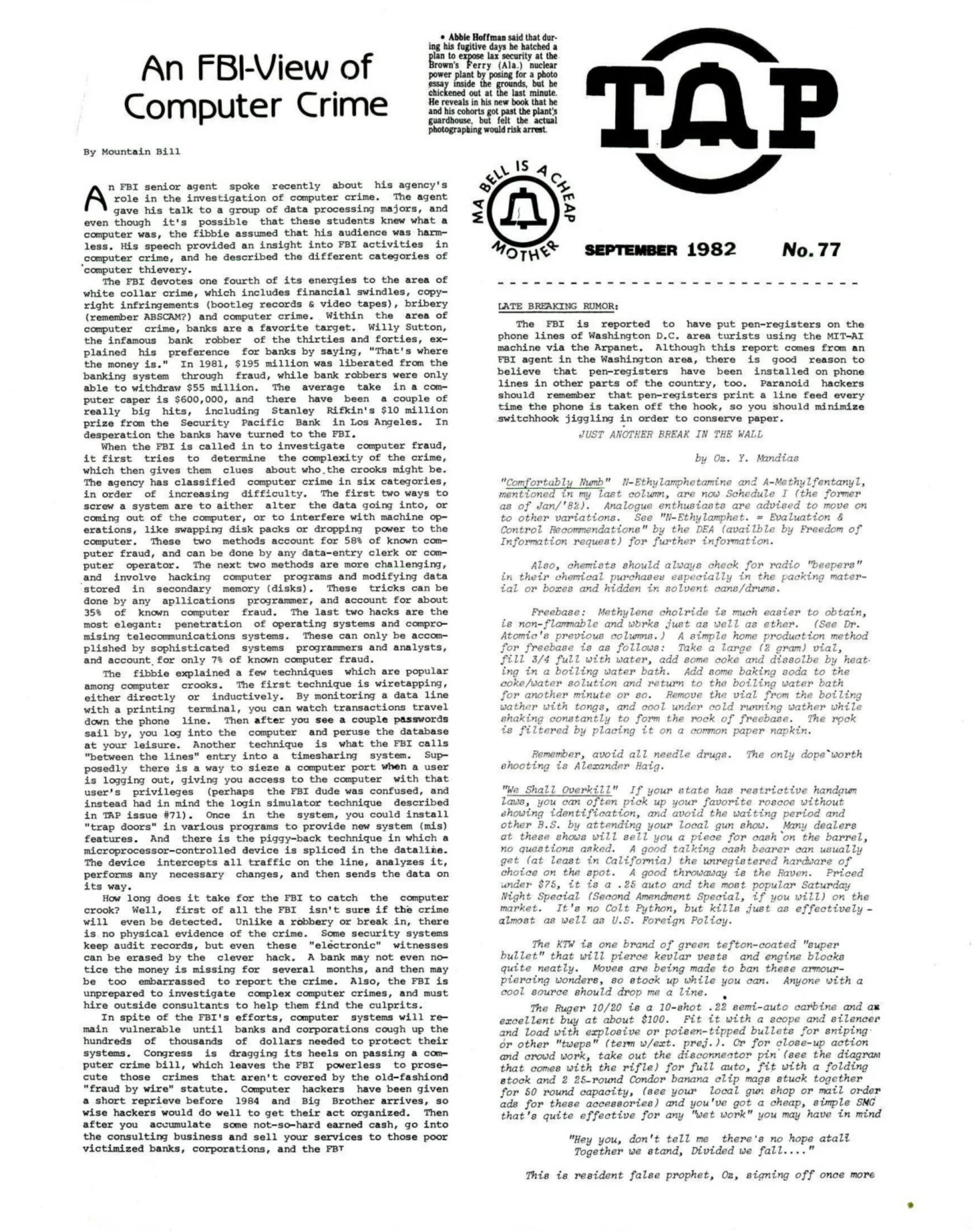
Summarizes a talk by an FBI agent on the bureau’s categorization of computer crime into six tiers of increasing technical sophistication, from simple data alteration by clerks up to penetrating operating systems and telecommunications networks, and cites the era’s benchmark cases including Stanley Rifkin’s $10 million wire-transfer fraud against Security Pacific Bank. Also reprints a rumor about pen registers being placed on lines suspected of ARPANET dial-up use, with a caution to hackers about phone-hook habits that pen registers can reveal. A companion drug-chemistry column update reports a legal-analogue compound’s reclassification to controlled status and advises readers to watch for hidden radio-frequency tracking devices (‘beepers’) in chemical shipments.
* Abbie Hoffman said that dur-
ing
his fugitive days he hatched a
lax security
at the
An FBI-View of
ern ge
Computer Crime = =cekenks
guardhouse, but
felt the actual
photographing
would risk arrest.
Is
oa,
A
role in the investigation of computer crime. ‘The agent
™
even though it's possible that these students knew what a
a]
computer was, the fibbie assumed that his audience was harn-
less. His speech provided an insight into FBI activities in
computer crime, and he described the different categories of
“computer thievery.
‘The FBI devotes one fourth of its energies to the area of
white collar crime, which includes financial swindles, copy-
right infringements (bootleg records & video tapes), bribery
(xemenber ABSCAM?) and computer crime. Within the area of
computer crime, banks are a favorite target. Willy Sutton,
the infamous bank robber of the thirties and forties, ex-
plained his preference for banks by saying, "That's where
the money is."
In 1981, $195 million was liberated from the
banking system through fraud, while bank robbers were only
able to withdraw $55 million. The average take in a com
puter caper is $600,000, and there have been a couple of
really big hits, including Stanley Rifkin's $10 million
prize from the Security Pacific Bank in Los Angeles. In
desperation the banks have turned to the FBI.
When the FBI is called in to investigate computer fraud,
it first tries to determine the complexity of the crime,
which then gives them clues about who.the crooks might be.
‘The agency has classified computer crime in six categories,
in order of increasing difficulty. The first two ways to
screw a system are to aither alter the data going into, or
coming out of the computer, or to interfere with machine op-
erations, like swapping disk packs or dropping power to the
computer. These two methods account for 58t of known com
puter fraud, and can be done by any data-entry clerk or com
puter operator. ‘The next two methods are more challenging,
and involve hacking computer programs and modifying data
stored in secondary memory (disks). These tricks can be
done by any apllications programmer, and account for about
35% of known computer fraud. ‘The last two hacks are the
most elegant:
penetration of operating systems and compro-
mising telecommunications systems. ‘These can only be accom
plished by sophisticated systems programmers and analysts,
and account, for only 7% of known computer fraud.
‘the fibbie explained a few techniques which are popular
among computer crooks. The first technique is wiretapping,
either directly or inductively. By monitoring a data line
with a printing terminal, you can watch transactions travel
down the phone line. Then after you see a couple passwords
sail by, you log into the computer and peruse the database
at your leisure. Another technique is what the FBI calls
“between the lines" entry into a timesharing system. Sup-
posedly there is a way to sieze a computer port when a user
is logging out, giving you access to the computer with that
user's privileges (perhaps the FBI dude was confused, and
instead had in mind the login simulator technique described
in TAP issue #71). Once in the system, you could install
“trap doors" in various programs to provide new system (mis)
features. And there is the piggy-back technique in which a
microprocessor-controlled device is spliced in the dataline.
‘The device intercepts all traffic on the line, analyzes it,
performs any necessary changes, and then sends the data on
its way.
How long does it take for the FBI to catch the computer
crook? Well, first of all the FBI isn't sure if the crime
will even be detected. Unlike a robbery or break in, there
is no physical evidence of the crime. Some security systems
keep audit records, but even these
“eléctronic" witnesses
can be erased by the clever hack. A bank may not even no-
tice the money is missing for several months, and then may
be too embarrassed to report the crime. Also, the FBI is
unprepared to investigate complex computer crimes, and must
hire outside consultants to help them find the culprits.
In spite of the FBI's efforts, computer systems will re~
main vulnerable until banks and corporations cough up the
hundreds of thousands of dollars needed to protect their
systems. Congress is dragging its heels on passing a com
puter crime bill, which leaves the FBI powerless to prose-
cute those crimes that aren't covered by the old-fashiond
fraud by wire" statute. Computer hackers have been given
a short reprieve before 1984 and Big Brother arrives, so
wise hackers would do well to get their act organized. Then
after you accumulate some not-so-hard earned cash, go into
the consulting business and sell your services to those poor
victimized banks, corporations, and the FBT
“STAs SEPTEMBER 1982
No.77
LATE BREAKING RUMOR:
The FBI is reported to have put pen-registers on the
phone lines of Washington D.C. area turists using the MIT-AT
machine via the Arpanet. Although this report comes from an
FBI agent in the Washington area, there is good reason to
believe that pen-registers have been installed on phone
lines in other parts of the country, too. Parancid hackers
should remember that pen-registers print a line feed every
time the phone is taken off the hook, so you should minimize
switchhook jiggling in order to conserve paper.
JUST ANOTRER BREAK IN THE
WALL
by Oz. Y. Mandias
"Comfortably Munb" N-Ethylamphetamine and A-Methyl fentanyl,
mentioned in my last colwm, are nav Schedule I (the former
ae of Jan/'82). Analogue enthusiasts are advised to move on
to other variations. See "-Ethylamphet. = Evaluation &
Control Recommendations" by the DEA (availble by Freedom of
Information request) for further information.
Also, chemists should always check for radio "beepers"
in their chemical purchases especially in the packing mater-
tal or boxes and hidden in solvent cans/druns.
Freebase: Methylene cholride is much easier to obtain,
is non-flarmable and works just as well as ether.
(See Dr.
Atomic's previous colwms.) A simple home production method
for frecbase is as follows: Take a large (2 gran) vial,
fill 3/4 full with vater, add some coke and dissolbe by heat
ing in a boiling water bath. Add some baking soda to the
coke/uater solution and return to the boiling water bath
for another minute or so. Remove the vial from
the boiling
wather with tongs, and cool under cold running vather while
shaking constantly to form the rock of freebase. The rock
filtered by placing it on a common paper napkin.
Remember, avoid all needle drugs.
‘The only doy
shooting is Alexander Haig.
“worth
"We Shall Overkill" If your state has restrictive handgun
Laue, you can often pick up your favorite roscoe vithout
showing identification, and avoid the waiting period and
other B.S. by attending your Local gun show. Many dealers
at these shows will sell you a piece for cash ‘on the barrel,
no questions asked.
A good talking cash bearer can usually
get (at least in California) the unregistered hardvare of
choice on the spot.
A good throwaay is the Raven. Priced
under $75, it is a .25 auto and the most popular Saturday
Wight Special (Second Amendment Special, if you will) on the
market. It's no Colt Python, but killa just as effectively -
almost as well as U.S. Foreign Policy.
‘The KIW is one brand of green tefton-coated "super
bullet" that will pierce kevlar veste and engine blocks
quite neatly. Moves are being made to ban these armour-
piercing uonders, 80 stock up while you can. Anyone with a
cool source should drop me a line.
,
‘The Ruger 10/20 ie a 10-ehot .22 eemi-auto carbine and aw
excellent buy at about $100. Fit it with a scope and silencer
and load with explosive or poieen-tipped bullets for sniping
or other "twepe" (term w/ext. prej.). Or for close-up action
and crowd work, take out the disconnector pin' (see the diagran
that cones with the rifle) for full auto, fit with a folding
atock and 2 25-round Condor banana elip mage stuck together
for 50 round capacity, (eee your local gun shop or mail order
ads for these aceessorice) and you've got a cheap, simple SNG
that's quite effective for any "wet vork" you may have in mind
"Hey you, don't tell me there's no hope atali
Together we stand, Divided we fall..."
This is resident false prophet, Oz, signing off once more
IBM TIME SHARING OPTION (TSO) - PART IZ
- Mick Haflinger
I hope that everyone has experimented with the
commands we learned last time because this month
we are going to talk about SUBMITting jobs and
running programs in the foreground (ie, inside
the TSO region). Foreground jobs are helpful
because snoopy operators will see
very little of
what goes on during your TSO
session.
Important: note- anytime you want to stop what
you are doing hit the ATTENTION key. If your
computer does'nt have one try the BREAK key.
This should get the message COMMAND INTERRUPTED
and *** which means hit the enter key to.return
to nozmal.
Now let's refer to your notes. Did you find
some datasets to play with? When you type in
"LISTD datasetname” it should reply like this:
"datasetname”
~~ RBCFM--LRECL-BLKSIZE-DSORG
FB
80
4240
PO
--VOLUNES~-
200000"
RECFN is recording format, FB is fixed block.
LRECL is logical record length while BLKSIZE is
block size..DSORG is the dataset organization,
PO being partitioned organization or a “library”
dataset that contains multiple members. Keep
trying until you find some good PO datasets.
Now see what is in the dataset by keying
"LISTD dataset M" to get a member list. You can
seleot a single member for edit by keying "EDIT
datasetname(member)". You may need to also
specify dataset type - ASM, DATA, or CNTL. It is
a nuisance but sometimes you must say NONUM for
unmumbered datasets. Remember if you get in
trouble, type in HELP. Some more notes on EDIT
are 1) if you hit the enter key tuice you go
into INSERT mode, just don't key anything and
hit the enter key to go back into EDIT
mode 2)
to end an EDIT session without saving any
changes type EXD NOSAVE 3) if you try to SAVE or
END you might be prompted for a password, just
hit enter a few times and get back to where you
can say END NOSAVE.
I£ you have been lucky enough to get into a
system with SPF or ISPF the job of snooping and
changing can be much easier. To find out if your
system has this use the "LISTA ST" command. A
sample output follows:
Is
=-ponane---prsP.
Samo,
datasetnane
D
%,
ddnane
disp
x
ny
s¥s1.UADS
=
E4
SYSUADS KEEP
ISP. TEST. ISPPLIB
ISPPLIB
WTA
The important item here is DDNAME which is your
clue to what your terminal can get away with.
The ddname ISPPLIB indicates that your terminal
is able to use SPF. Key in SPF and find out! If
SYSUADS is present then you can use the OPERATOR
command. Don't try it now.
Use the KELP
OPERATOR command first to find out how to use
it. The OPER. command is very powerful and can be
used to set up new accounts, change passwords,
change priorities, cancel users, etc.
What we are going to do now is find out what
datasets the host system has online. This is
done with a LISTCAT command and it is preferable
to do this in "batch" rather than "foreground".
t£ you found a PO library dataset earlier you
can look at its member list for interesting
material. Since all batch jobs must have a
jobeard, find a library that has a name ending
in CNTL or ASM. These usually contain JcL (JOB
CONTROL LANGUAGE) statements for running
programs. Normally the programmer has these set
up to run with valid jobcards and such. If you
have SPF then scanning the libraries will be
easy, follow the menu and don't save anything.
However most of you will only be able to use
standard TSO so pay attention and have fun.
First find a valid member and write down the
jebeard which will look like //XXXXXXXX JOB
(99999,xxxx,xxx) depending on the system.
The
first 8 X's are the jobname and you may want to
use his jobname to sinimize the chances of
axousing the sleeping operator. The stuff inside
the parenthesis is the job accounting data
so
don't try to improve on it.
Now let's create a
member for ourselves. I
will assume that you are using standard TSO.
Enter “EDIT dsname(member)". Hopefully the
dsname is one that you found allocatéd to your
logon. Remember that dsnames might have to have
apostophes around them and pick a member
ni
that is not being used. This is what your screen
should look like.
"EDIT TEST(NICK) asm”
(you key this in)
DATA SET OR MEMBER NOT FOUND, ASSUMED TO BE NEW
INPUT
000010_
(start keying following code here)
//jobname JOB (put the jobcard here)
7/STEPO1
EXEC PGM=IDCAMS.
//STEPCAT DD DSN=SY¥S1.VSMASTER, DISP=SHR
//SYSPRINT DD SYSOUT=*
7/SYSIN
DD *
LISTCAT CATALOG(SYS1.VSMASTER)
”
Your catalog name may be different, see previous
comments on LISTD and LISTC commands.
O£ course if you find a member that you can use
just CHANGE it as needed and then SUBMIT the
job and then EXD NOSAVE. Before doing this use
the HELP command to learn about the preceding
CHANGE and SUBMIT commands. Also you must use
the OUTPUT command to see the printout of any
job you run. Make sure that the job says in
the jobcard, "MSGCLASS=U" and all dd cards
say "SYSOUT=*" or the operator will get your
printout.
Next time we will have a lesson in basic Ian
utilities and what they can do for you. This
is just kinda off-the-cuff, so urite me and
let me know what you need to know. I WANT
SOME FEEDBACK. Send it c7o TAP. Maybe I can
set something up on one of the computer
networks.
DOCTOR ATOMIC'S UNDERGROUND DRUG NEWS
LIFE EXTENSION: Deanol. (Syn Deaner. Chemical
name--dimethylaminoethanol (DMAE)). Active and
water soluble in its bitartrate and hemisuccinate
forms. Reported to be a safe, natural stimulant
that elevates mood, increases intelligence, and in-
creases lifespan. (See Secrets of Life Extension
by John Mann, p. 40, And/or Press 1980, available
from Loompanics.) Deanol is available without pre-
scription from chemical supply houses and is inex-
pensive. Life extension dosage is 100-150 mg per
day; therapeutic dosage is 300-400 mg a day, and
CNS activity is strong enough to require a warning
to take it in the morning to avoid insomnia. In
addition to promoting life extension, Deanol may
also get you high. As a scientific courtesy, would
someone who has taken a therapeutic dose let us
know if it is any good?
UP:
Fencamfamine. Chemical name N-ethyl-3-phenyl-
norboranamine hydrochloride. This is a stimulant
and anti-depressant. It's available from chemical
supply houses OTC since it is not a controlled sub-
stance. Fencamfamine produces an effect somewhere
between cocaine and methamphetamine, but it is not
as powerful as either; however, it is euphoric.
If
England it's a prescription drug called "Reactavan",
and is sold in 10 mg pills. A larger dose, 30 to
100 mg, may be needed to produce euphoric stimula.
tion. Sniffing fencamfamine is harsh on the nose
like methamphetamine, so it's best taken orally.
Some people take it dissolved in coffee. The price
is affordable: $30 to $70 for 50 grams from chemi-
cal supply houses.
BOOK:
The MERCK INDEX is a chemical reference book
‘that will become as indispensible and as used as
your dictionary. The "Merck"
is more comprehensive
in many ways than the Physician's Desk Reference
(PDR) because it gives data for many household and
food chemicals as well as for drugs. Available
from the Merck Co., P.O, Box 2000, Rahway, NJ 07065.
Price is about $25.00.
HIGH VOLTAGE:
A high tech pot garden was busted in
Novato, CA =- the police claim that their attention
was drawn to the warehouse mainly because of a sud-
denly high consumption of electricity needed for
halide lights. (See High-Times, May '81, p. 20 for
details.) Electric heating mantles also drain a
lot of power and may, therefore, also draw the at-
tention of the DEA.
See the TAP Index "Free Elec-
tricity" for electric meter jumping instructions,
Don't advertise your lab or indoor farm with a high
electric bill.
MORE ON COMPUTER SECURITY
by Simon Jester
In issue #75 I talked about a new way to
break into large computers that has the experts
shitting in their pants. Well, I found out how to
do it about a week after I mailed in that article,
so here it is. This will work on almost all main-
frame (maxi) systems, and most mini systems too,
but it won't work ona micro. The scam lets one
person on one terminal take control of another
person operating on another terminal, so naturally
it won't work on a micro.
The system you are using must have a function
that lets you send messages from one terminal to
another. This is sometimes called interterminal
mail service. It must also have intelligent
terminals hooked up, or at least the terminal that
you take over must be intelligent. The soam takes
advantage of two features in the intelligent
inal, first the ability to send data in “block
+ This is where you enter data into the
terminal and it stays on screen, in the terminals
memory, without being transmitted to the host
computer. You can then edit it, and when you are
ready to send it, press a "send" key. The entire
block of data will then be transmitted. The second
feature you take advantage of is called "soft keys".
20 control the editing of the block of data, there
are special keys, which generate control characters
when pressed. These are interpretted appropriatly
by the terminal. The terminal can't tell if the
control characters come from the keyboard or from
the computer. So, the-rest is obvious. You log on,
and send some guys terminal a message putting it
into block mode. Then you send the appropriate
commands to put 620 million into your account. These
are stored in the block of data to be later
transmitted, since you are in block mode and the
terminal can't tell it's keytoard from the host
computer. Then you send the transmit signal. ‘he
terminal transmits the order for the extra 20 mil,
and the computer, being stupid as a post, does
what it has been ordered to by the terminal.
This lets you take control of another users
workspace, and you can manipulate his data sets,
copy out protected information, or generally get
access to things that you aren't supposed to be
able to get into. Now some of you are going to say
“thats obvious, why waste TAP space with it?" But
the point is, this scam isn't obvious. I knew atout
all the things that you need to do it for a long
tine, but I never thought of this until I heard
about it. And the beauty of it is, it's so simple
that there are almost no ways to protect against
i.
There are several suggested ways of protecting
against this scam, One is to disable the intelligent
terminals. If you do this, you lose all the features
of the intelligent terminal, so this isn't very
practical, Another suggestion was to disable the
interterminal mail service. This is also kind of
a@ stupid idea since you lose the entire nail service
capability. There was one practical suggestion
by the security experts. Put a software filter in
the computer that doesn't allow control characters
to he sent from one terminal to another. This will
keep you from taking control of the other terminal
at all. I have a suggestion to get around thi
The set of ASCII characters range fror. 0 to 127.
“ost filters
will take out the control characters
in that range. Dut there is also a duplicate set
of ASCII characters from 128 to 255, with 128
corresponding to 0 and 255 corresponding to 127.
These characters are identical to the first set,
tut they are called the high order characters
because they have their highest priority tit set.
They will do the same thing as the first set. but
you can't generate them from your keytoard, you
have to write a program and use the CHK} function
or its equivilent to generate a character from the
high order set. Another suggestion is to try to find
a different sail utility, one that might not have
the filter. There are usually several. Gne usually
lets two users talk directly. Another lets you
leave messages for another user, who will look at
then later. “hen he logs in, it may print out his
ressazes, or inform hir that he has a few. when he
reads them,
he gets blown off, The advantage of this
is that you don't have to te logged on when he gets
Blown off his terminal, everything is prerecorded.
4 few more hints. There is usually a function
to lock the keytoard on a terminal, you may want
to use this to keep the guy fror trying to inter-
fere ac his account is getting fucked over. There
vay even be an option to supress printing on his
screen, If there is, you may te atle to do the whole
scam quickly, then return control to him by unlock-
ing his keyboard, and he might not even notice
that anything happenned for a while. Another hint
towards this end is, if you are doing thg whole
scam while you are on-line, to write a program
which will do the whole thing. Then you just start
it up, and sit back. The whole thing should be done
in less than a second. If you can keep anything from
showing on his screen, or clear his screen after-
wards, he may not know anything happenned. Of course,
you may want to set up a batch job or use the
delayed message so you can say you weren't even
logged on when the breakin happenned.
There is a report from SRI (Stanford Reasearch
Institute), which I have sent to Tom. I'm sure he
will send you a copy, but it isn't too goo
(Thanks for the report,Donn, -Simon) There is also
info on this scam in one of the January issues of
InfoWorld (it comes out weekly), I don't know
which issue, and in either the January or February
issue of Science magazine. If you can get either,
please send it to me c/o TAP. Keep on Phreakin*
and don't get caught!
-Simon
More Confusion About AUTOVO!
is,
Fred Steinbeck
After following the controversy about AUTOVON
throughout the history of TAP, I thought I'd try a
couple of military friends of mine and see what I
could see.
After a little bit of digging, I came up with a
Navy guy, who I shall call Jeff, for sake of
argument.
Jeff told me what little he knew about AUTOVON, and
much of it came as a surprise. First, he does not
have a touch-tone phone on his desk; it's a rotary
dial type (not only that, but he says he has never
seen a touch-tone AUTOVON phone!). Second, I asked
about the FOFIP signals (Flash Override, etc.) and
he came back with a very surprising answer: AUTOVON
no longer uses the FO signal, and it has changed
the names of a few others. The new signals are:
FLASH: This signal seems to take the
place of Flash Override. The official
definition of this signal states that it
is only to be used when there is a
situation which is “immediately
detrimental to the security of the United
States."
IMMEDIATE: Immediate calls are the next
lowest priority - they are calls whose
information must get through in two hours
or less.
PRIORITY: These calls carry information
which must be put through in six hours or
less.
ROUTINE: These calls are the normal type
of calls which are made by AUTOVON users.
That is, they are just calls which don't
have too much to do with national
security, etc.
According to. Jeff, when he wants to make a call to
another place on his base, he simply dials the four
digit number. If he wants to use the Bell outside
lines (tovcall home, for example), he dials ‘9!
first, and then the number.
Now, for AUTOVON calls, he dials '8' first, and
then the 7 digit AUTOVON number. Note that this
only allows him to make ROUTINE ‘calls - no Flash or
other kinds of calls.
Assuming he were to want to make a call with a
Priority above Routine, he dials '0' for operator
and says, "Operator, Immediate priority call to
So-and-such, please." Now remember, AUTOVON numbers
are seven digits. He says the operator then dials
(with touch-tone, not rotary) two digits, and then
what he thinks are his seven digits. So, assuming
the operator were to have to dial '8' to access
AUTOVON, then next digit should be the extra one -
the one which tells what priority the call is!
I don't know how much of this is applicable to all
AUTOVON systems - Jeff has only had experience with
his phone, and I don't know how much he really
knows, and how much is speculation on his part.
If you have any comments or questions, send them to
me, Fred Steinbeck, c/o TAP, or better yet. write
an article!
OK, BUDDY, LETS SEZ YOUR REGISTRATION
By Cheshire Catalyst
As the Bull System begins its reorganization,
we Phone Phreaks also have to start getting our
act together as well. One thing that has come
about in the wake of the new de-regulation of The
Phone Company is the FCC Registration program. —
Under
this
program,
the
FCC
registers
equipment that will be connected to the telephone
line. This is so that TPC will be aware of what
equipment may be connected to its circuits in case
the big bad customer owned equipment blows up, and
causes damage to nice, sweet telephone network.
If you are like most of us here at TAP, our
equipment is Genuine Bell (as the new ads say),
but comes to us via the Manhattan Pothole Company.
The Manhattan Pothole Company is the outfit that
digs the potholes in the streets around New York.
The Phone Company then drives its trucks over the
potholes, and equipment then,
"Falls off the
truck," as we say in the trade. Accordingly, it
may be inconvienient to give TPC a registration
number from the bottom of one of their phones.
Therefore, It's time to begin the TAP Registration
Program. We will publish the registration numbers
of non-Bell equipment as a service to our readers.
Please turn over any device you see connected to a
phone line, write down what it is, what it does,
and the FCC registration number,
and ringer
equivilance number. We'll publish them in future
issues of TAP. Here's the first batch:
ITT Slimline (Touch-Tone)
FCC Reg # AS293P-70038-TE-T
Ringer Equivilance 1.0A
usoc # RJ11-C
Tel-A-Tone Ringer (Auxiliary Ringer)
FCC Reg # AZ3899-62695-OT-N
Ringer Equivilance 0.4B
Stromberg 2500 Desk Phone (Touch Tone)
FCC Reg # AS293P-70088-TE-T
Ringer Equivilance 1.0A
Crest Two Line Electfonic Phone Model # E2-2500T
This goodie handles two phone lines.
FCC Reg # BL-685L-69731-TX-N USOC # RJ41-C
Northern Telecom Rendevous (Touch Tone)
FCC Reg # AB6982-68817-TE-T
Ringer Equivilance 0.7A
Inmates build helicopter
CARSON CITY, Nev. — A plumber, a welder and an electrician
locked in a maximum-security prison almost managed to build a
helicopter because the staff “didn’t see the significance” of parts
scattered around the prison shop, an official says.
The inmates were short only the big rotor blade when their one-seat
creation was found yesterday at the Nevada State Prison, officials
said.
“We do have people in here who are journeymen,
who are skilled
craftsmen in their trades,” said Vernon Housewright, the state
prisons director.
77
“ts time to get back 10 the rea! business of
‘government . . . getting reelected”
Fussbuster
‘Tred of those half-assed cops always reporting
you on their little radios?
Well this ultre-cimple
efrout vill Jam all communications using YM such
YM radio, TV, 2 meters and of course eop radio
Ite output
ranges from about 50 to 900 Mis, The oireut
needs from 9 to 16 volts and draws about 5
Te
transistor can be any HPN general purpose
such as the
283904 or 284124, The eoil oan be made by winding 9
turns of 18 or 20 AWG wire around 8 $" DIA paper
tube, This eireut can also be used as @ mio by putting
bon mierophone ( such’as @ telephone mouthpiece )
in series
with the battery.
‘The Stainless Steal Rat
Ante
to pen ao bills.
cul
one
;
cut out this chart.
(nack Tssues are $.75 each. Issue #50 is $1.59.
| Subscriptions - 10 issues - US Bulk Rate $7.
US Bulk Envelope Rate $8.
| US First Class in plain sealed envelope $10.
Canada & Mexico First Class $10.
| Foreign Surface $9. - Foreign Air Mail $12.
IMPORTANT! Please include your mailing label or a
| Kerox copy whenever you write to TAP about your
subscription.
VElectronic Courses - $.75 each. A - DC Basics,
1,~
AC Basics, C - phone Basics, D - Amplifiers.
TAP "Ma Bell" Patch - $1.50.
| TAP "10th Anniversary" Pen - $.50.
TAB Cassette
Tepe -
S450. Hear Capt Crunch, Al Bell,
\Joe Engressia & Bell Security Chief John Doherty.
TAP Fact Sheet #1 - §.50. Credit card call hints.
TAP Fact Sheet #2 - $.50. Free BELL phone calls.
TAP Fact Sheet #3 - $.50. Free GTE phone calls.
TAP Fact Sheet #4 - $.50. Dual Tone Oscillator,
Displayed Red Box, & 2600 Whistle Perfector plans.
ySend CASH, check, or money order to =
| ZAP. Room 603
= 10036.
147 West 42nd Street, New York,
'
a
TAP, Room 603, 147 W. 42 St., NY 10036
Bue Rate
Us. Postace
PAID
Perit No.3
ewsey, td