November 1, 1982 · TAP
TAP No. 79 - Blue Box Equipment and Usage
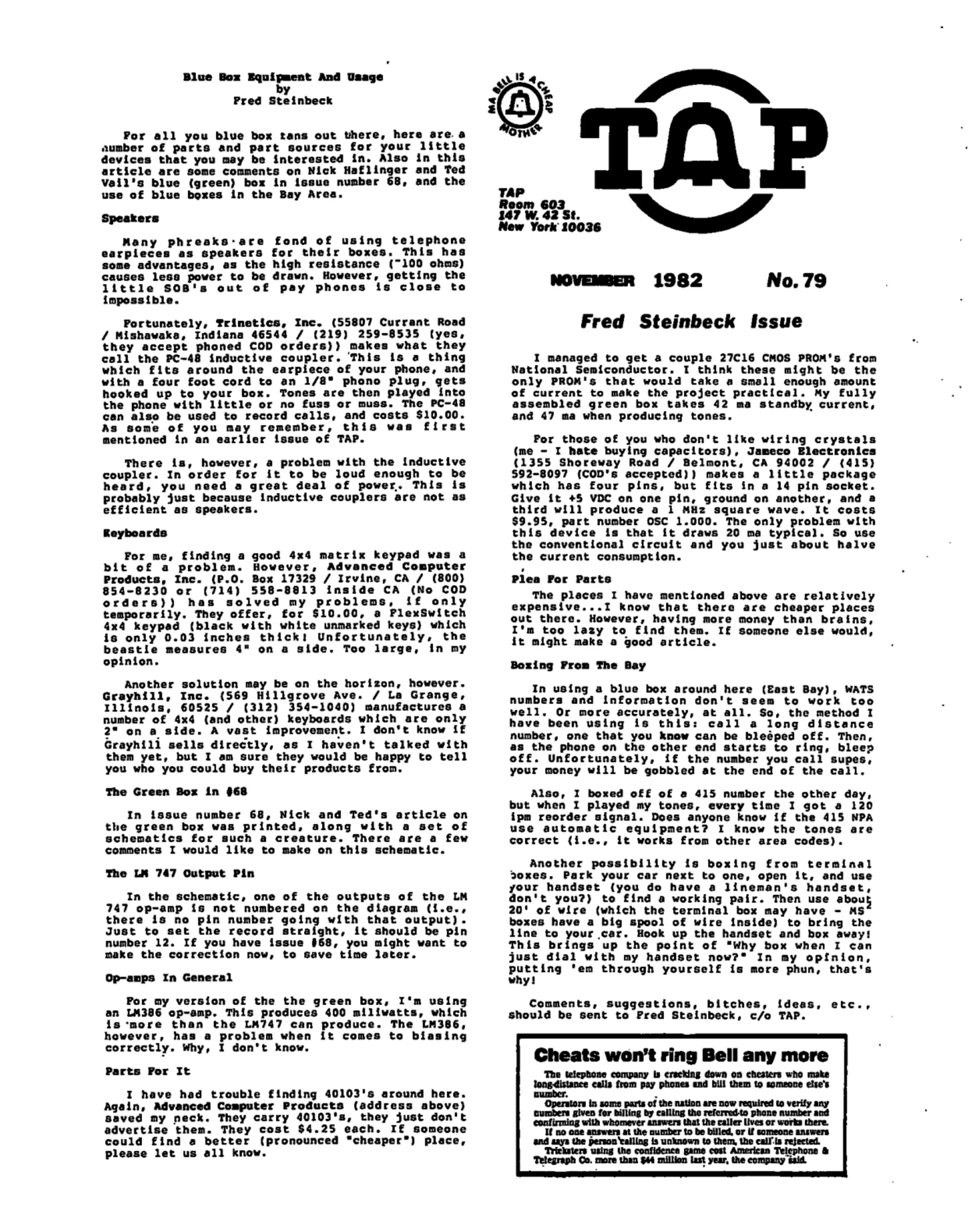
A reader-contributed roundup of mail-order parts sources for blue-box hobbyists, covering inductive telephone couplers for playing tones into a handset without opening it, 4x4 matrix keypad options and their tradeoffs (size, thickness, cost), and low-current crystal oscillator modules, with specific supplier names, addresses, and prices current to late 1982. Also comments on an earlier issue’s coverage of a ‘green box’ built by pseudonymous phreaks Nick Haflinger and Ted Vail, and reports the author’s own assembled box’s standby and active current draw.
Blue Box Equipment And Usage
Pred Steinbeck
Por al] you blue box tans out there, here are
a
aumber of parts and part sources for your little
levices that
you
may be interested in. Also in this
rticle are some comments on Nick Haflinger and Ted
11's blue (green) box in issue number 68, and the
use of blue boxes in the Bay Area.
Speakers
Many phreaks-are fond of using telephone
earpieces as speakers for their boxes.
This has
some advantages, as the high resistance (“100 ohms)
causes less power to be drawn. However, getting the
little SOB's out of pay phones is close to
impossible.
Portunately, Frinetics, Inc. (55807 Currant Road
/ Mishawaka, Indiana 46544
/ (219) 259-8535 (yes,
they accept phoned COD orders)) makes
what they
call the PC-48 inductive coupler.
‘This is a thing
which fits around the
earpiece of your phone, and
with a four foot cord to an 1/8* phono plug, gets
hooked up to your box. Tones are then played into
the phone with little or no fuss or mu:
‘The PC-48
can also be used to record calls, and costs $10.00.
As some of you may remember, this was first
mentioned in an earlier issue of TAP.
There is, however, a problem with the inductive
coupler. In order for it to be loud enough to be
heard, you need a great deal of power. This is
probably just because inductive couplers
are not as
efficient as speakers.
Keyboards
For me, €inding a good 4x4 matrix keypad
was a
bit of a problem. However, Advanced Computer
Products, Inc. (P.O. Box 17329 / Irvine, CA / (800)
854-8230 or (714) 558-8813 inside CA (No COD
orders)) has solved my problems, if only
temporarily. They offer, for $10.00, a FlexSwitch
4x4 keypad (black with white unmarked keys) which
is only 0.03 inches thick! Unfortunately, the
beastie measures 4" on a side. Too large, in my
opinion.
Another solution may be on the horizon, however.
Grayhill, Inc. (569 Hillgrove Ave.
/ La Grange
W1linois, 60525 / (312) 35.
number of 4x4 (and other) keyboards which are only
2" on a side. A vast improvement. I don't know if
Grayhili sells directly, as I haven't talked with
them yet, but I am sure they would be happy to tell
you who you could buy their products from.
The Green Box in #68
In issue number 68, Nick and Ted's article on
the green box was printed, along with a set of
schematics for such a creature. There are a few
comments I would like to make on this schematic.
The LW 747 Output Pin
In the schematic, one of the outputs of the LM
747 op-amp {5 not numbered on the diagram ({.e.,
there is no pin number going with that output).
Just to set the record straight, it should be pin
number 12. If you have issue #68, you might want to
make the correction now, to save time later.
Op-anps In General
For ay version of the the green box
an LM386 op-amp. This produces 400 milivatts,
which
is‘more than the LM747 can produce.
The
LM386,
however, has
a problem when it comes to biasing
correctly. Why, I don't know.
I'm using
Parts For It
I have had trouble finding 40103's around here.
Again, Advanced Computer Products (address above)
saved my neck. They carry 40103's,
they just don't
advertise them. They cost $4.25 each. If someone
could find a better (pronounced “cheaper”) place,
Please let us 411 know.
TAP
Re Fh a
New York 10036 AP
wT”
NOVEMBER 1982
No.79
Fred Steinbeck Issue
I
managed to get a couple 27C16 CMOS PROM's from
National
Semiconductor. I think these might be the
only PROM's that would take a small enough amount
of current to make the project practical. My fully
assembled green box takes 42 ma standby current,
and 47 ma when producing tones.
For those of you who don't like wiring crystals
{me = I hate buying capacitors), Jameco Electronics
{1355 Shoreway Road / Belmont, CA 94002 / (415)
592-8097 (COD's accepted)) makes a little package
which has four pins, but fits in a 14 pin socket.
Give it +5 VDC on one pin, ground on another, and
thied will produce a 1 Miz square wave. It costs
$9.95, part number OSC 1.000. The only problem with
this device is that it draws 20 ma typical. So ui
the conventional circuit and you just about halve
the current consumption.
Plea For
Parts
‘The places I have mentioned above are relatively
{
I know that there are cheaper places
ever, having more money than brains,
I'm too lazy to find them. If someone else would,
it might make a good article.
Boxing From The Bay
In using a blue box around here (East Bay), WATS
numbers and information don't seem to work too
well, Or more accurately, at all. So, the method I
have been using is this:
call a long distance
number, one that you know can be bleéped off. Then,
as the phone on the other end starts to ring, bleep
off. Unfortunately, if the number you call sup
your money will be gobbled at the end of the call.
Also, I boxed off of a 415 number the other day,
but when I played my tones,
every time I got a 120
ipm reorder signal. Does anyone know if the 415 NPA
use automatic equipment? I know the tones are
correct (i.e., it works from other area codes).
Another possibility is boxing from terminal
boxes. Park your car next to one, open it, and use
your handset {you do have a lineman's handset,
don't you?) to find a working pair. Then use about
20' of wire (which the terminal box may have - MS
boxes have a big spool of wire inside) to bring the
line to your car. Hook up the handset and box away!
This brings up the point of
“Why box when I can
just dial with my handset now?" In my opfnion,
Putting ‘en through yourself is more phun, that's
why!
Comments, suggestions, bitches, ideas, etc.,
should be sent to Pred Steinbeck, c/o TAP.
Cheats won't ring Bell any more
The telephone company Is crecking down on cheaters
who make
longdistance calls from pay phones and bill them to someone else's
umber,
A
‘Operators in some parts of the nation are now required to verify any
umbera given for billing by ealling the referredto phane number and
‘confirming with whomever answers that the caller lives or works there.
If no one answerg at the umber to be billed, or if someone answers
‘and says the person ealling is unknown to them, the eall.is rejected,
‘Tricksters using the configence game cost American Telephone &
‘Telegraph Co. more than $4 million last year, the company éaid,
‘The ARPANET
-(@art I: An Introduction)
by Pred Steinbeck
What It Is
‘The ARPANET, also referred to as the ArpaNet, is
one of the largest governmental computer networks
in existence. It was established in the late 1960°
ntal network. It was so
.
and more comput.
nd now it is
the main government
computer network. It was
originally
sponsored by
the Defense Advanced Research Projects Agency
(DARPA - the people who brought you the
M16 rifle),
but now
it 1s run and spo!
tl
partment
Of Defense (DOD)
and the
De:
Communications
Agency (DCA - Note that their military counterpart,
the Defense Comaunications Command, or DCC, are the
folks who brought you AUTOVON and AUTODIN).
purely
an expert
Access to the ARPANET is given only to people
who "need" access. That ia, if a person has a
government project which would require use of the
net, they would be granted access. As it is now,
many institutions hav
network via
computers known
« Most (1£ not
all) TAC's
and T:
dialup ports (without
pasawor
I might add). Because of this,
Joe
Nobody can
get onto the networ
1 it tekes is a
little know how.
What It's Good For
There are basically two things you can do with
the network. First, if you have access to a
computer connected to the ARPANET, you can probably
send electronic mail over the network. This 1s fun,
but not truly anything to get overheated about.
The second thing you can do with the ARPANET is
called
use it to connect with remote computer:
hosts. THis is much like Telenet
Montgomery's
article in issue 74). Oni
connect to the remote computer through your dialup,
you can attempt to login (net that you'd ever do
that, of course...)
There are two basic ways of getting access
to
the network. The first method is to find the dialup
number of @ TIP or TAC in your area, Then call the
number and use it to connect to the computer that
your interested in (I realize that's
not very
specific, Parts II and III of this.series wil}
cover doing just that...)
The second method is just
good, but it works
only if you already have access to 6 compute:
connected to the ARPANET. If you do, look'for a
program called, curiously enough, "tip". This
is a
program which allows your computer to simulate a
TIP. Because the program "TIP" is different on
almost every machine, I can't explain exactly how
to use it - you'll have to look up the information
in the computer's manual.
Getting A TIP Or TAC Mumber
Most major universities and colleges are
connected to the ARPANET. Also, large corporations
or companies
doing business
with the government may
be connected. Here are
some specific places that
have TIP'g or TAC's:
Gunter Air
Air Force
+ Washington;
Arwy Communications
Electronics Command, Port Monmouth, NJ; Bolt,
Beranek and Newman, Inc., Cambridge, MAr
Massachusetts Institute Of Technology, MA) MITRE
Corp., VAy Moffett Pield, CA; National Bureau Of
Standards, Washington; Rockwell Intl., Richardson,
‘TX; SRI International (our favorite!), Menlo Park,
CA; Stanford University, CA; The Rand Corp, Senta
Monica, CA; University Of Southern California; and
the University Of Utah.
My, all those Air Porce Ba
While! you're
there, perhaps you could ask about
AUTOVON,’ too! In
tting TIP/TAC numbers,
wi
itting techniqu
rat,
ts at the university or
college in question - they'll probably know,
and
won't mind giving them
out. As far as
government
Places ({.e.,
Air
Bases), well, just have a good
story: I saw the other
day
at @ National Guard
Armory @ nocice about how @ guy
posed as 2
intelligence officer and
walked into the A
of the armory and took an M16Al rifle.
The military’
isn’t all that tough...
So, for now, you mission is {if Jim Phelps will
allow me to borrow his line) to find out the TIP
and TAC numbers in your area, Later issues will
have parts It and III, which cover actually using
the net. Stay cool ‘till then.
by Pred Steinbeck
Dialing The
met
Ok, now you've got a TIP or TAC number and
you're just waiting to find out how to screw with
the ARPANET, right? Well, first thing is to call
the TIP/TAC number. It will give an answer tone, so
your modem (presumably 300 baud) should be set for
originate.
Nothing nappensi Nothing is, printed on the
screent Fantastic, The TIP or TAC {s waiting for 8
hunt character, a character which will tell it what
speed you are running at.
If you have
the dialup for a
control-Q. You should then get the me
+ type a
coe
<Sitename> TAC <version #> <port #>
Tf you don't, or if the message is garbled, hit
the break key (for people without "break" keys, try
hitting the "4" sign button on a touch-tone phone)
and then type another control-Q. If this doesn't
work, let me know by mail, and I'll see 1£ I can't
figure something out for you.
TIP's are another story entirely. They are a
general
pain in the ass to work with. The hunt
ch.
ters for TIP's
vary depending on the baud
rate and the device that you are using to connect
to the TIP.
If you are ASCII 110, 150, or 300 baud, the hunt
character is "E" (upper-case). If you transmit
ASCII 300 baud, but receive at 1200 baud, the
character {s "D".
ASCII 1200 baud doesn’t need a
hunt character. Assuming you get the hunt character
to TIP ok, you should see the TIP signon messa
which is like the TAC signon. Note that ASCII
1
baud people don't get a signon message.
Using The wet
The
re two commands we are concerned with.
The first is "@o host/imp", which tells the TIP/TAC
to open
@ connection to the specified host and imp
address. The second command is "@c" which stands
for “close", and is used
for
(surprise!) closing
the connection. The "o" and
do not necessarily
have to be in lower-case.
A host/imp address specifies the computer that
you wish to connect with. The computer you will
most probably want to connect with first is the
Network Information Center at SRI International.
The host/imp
address for this is "0/73", so the
command to connect to it is
@o 0/73
The Network Information Center
require an account - when it types
*
“NICGUEST" or "NIC" and hit return.
SRI-NIC) wil)
type either
The NIC system is pretty straightforward, but
obnoxious to use. It allows you to get information
on other computers on the net, how to order (by
U.S. Mail) manuals from SRI, internet protocols,
etc. In short, after screwing with it for a while,
you will learn enough about the net to go off on
your merry way.
Oh, when you get tired of a connection, simply
type
"@c"
and hit return. This will close
the
connection and bring you back to the TIP/TAC
command mode.
This {s really a bare-bones
course on the
ARPANET, but it should be enough to get you out
there, nethacking to your heart's content. Next
month wil] be part III, general netnotes. If, in
the meanwhile, you have questions or comments, send
them _to Pred Steinbeck, c/o TAP.
Gibberish
by
teed Steinbeck
This colunn of mine will cover many topics, some of
which I have dealt with before ~ in short, it's a
potpourri of various things...or, gibberish.
Books to get: An excellent book I have just
finished looking over is Signalling In Tele-
communications Wetworks by Samuel
Welch. This book,
although rather technical, covers
SF
signalling, MF
interoffice signalling, CCIS (common channel
interoffice signalling, also known as
plain ol'
common channel signalling, CCS), and
many other
topics.
Highly recommended.
Bo
I'd like to get: In issue number 68, The
Magician wrote about the Bell book Notes On
Distance Dialing, mentioning that it used to cost
$12.95. He also said to send a SASE for more info
on getting it. Would it not be easier to tell how
in TAP? Or is it one of those things that is better
left to a limited readership?
Along the same lines, how does one get a copy of
the CCITT Green book, or the
Bell 100
Series Test
Codes? I'd like to get
th
,»
but TI ha
not been
successful yet...perhaps somebody will take pity
and send some info in, huh?
Articles: The July Penthouse magazine has an
article on computer crime. Believe it or not, this
article
mentions our good friend Donn Parker, as
well as Susan Thunder, the 8BBS, and the COSMOS
computer system...worth reading, perhaps.
Sprint: In the last issue, number 76,, there was @
list of Sprint dialups across the nation. However,
one I used to use in Oakland, (415) 832-5015, wa
omitted. While I apprec
the effort that went
inte compiling such a list, is it possible there
are more additions?
Garbage:
Garbage can provide an excellent source of
information...dialups, passwords, computer logins,
etc. Try going through your local ESS dumpster late
at night and see what's there. Or perhaps a stock
market place. Or bank (be careful, though). I think
you'll be surprised at what you'll get (besides
£1
and the plague)!
Newslines: Here are a couple in the Pac Tel area,
from Bell's own newspaper, Update:
(415) 45-8800 San Francisco (or)>-1
(800) 882-1061 (from California)<--1
(408) 491-7777 San Jose
(714) 237-3111
San
Diego
(714) 835-5111 Orange-Inland Empire
The San Jose number in {ssue number 65 is
disconnected.
AUTOVON: I talked with another guy, this one an
slectrenios tech with the Navy. I got the following
‘rom
him.
AUTOVON is sponsored by the Defense Communications
Command (DCC). They are the military counterpart of
the Defense Communications Agency. The Air Force
are the main AUTOVON users, and the Navy uses it a
good
1 too. There is another service similar to
AUTOVON called AUTODIN, which stands for AUTOmatic
Digital Information Network. It is used only for
connecting computers together.
At any given time,
the military controls / uses 3%
to 78 of the nation's long distance lines. However,
in an emergency, at the pr
of a button, a
computer called SCAN in Omaha will grab onto 908 of
the civilfan long distance lines for military use.
Could be cute to get the dialup to SCANI
Last, more and more AUTOVON traffic is being put
through government computers called STEAMVALVEs,
which are
essentially over-grown voice encrypters.
I seem to have run out of things to write about.
Comments or questions should be directed to me c/o
TAP. Or, like I
said, write an article
Gibberish It
by
Pred Steinbeck
Welcome again to a collection of oddities and
bizzareness in the phone phield. Much of this
month's material comes
straight from the horse's
ass, so to speak ({.e., the Bell System).
Ah, yes, the infamous ESS, or Electronic
Switching System. The very word strikes
terror into
the heart of a phone-phreak. First the bad news, I
igo in the May /
ra magazine,
and
found that 518 of all switching centers across the
U.S. are now ESS's.
It took Bell 17 years to
t
the first half done, and it is expected to take
another
10 years to finish the job. 1992, phriends.
*
Sigl
Mew Payphones?
In the March ‘82 issue of Record,
If saw that
Bell is working on a new pay phone. This
one is
known as the “electronic® model (as
opposed to the
old one?) In any case, the thing
a little better
armored, and is alleged by Sell Labs to produce
2200 & 1700 Hz more accurately. Tt's also supp
to detect slugs
and
foreign coins better. We shall’
see, as it {s supposed to appear in 1983.
Automated Coin Toll Service (ACTS)
Around here (Bay Area), we have a new computer
called ACTS. This computer runs under stations
which have TSPS, and basically tries to impersonate
an operator. ACTS is used with pay phones, for long
distance calls. For example, you put in your dime
and dial a long distance call. You hear a voice
(with
an
80 word vocabulary, no less) come on and
say,
“Thirty five cents p:
(2 second pause)
Please deposit thirty five cents for the next three
minutes." If you talk for more than
the three
minutes,
and then hang up, ACTS will call back and
demand your money...
More bad news - ACTS, being a computer, can
detect coin toll fraud (i.e., red boxes) better
than operators. I, would assume it would measure the
duration and frequency of the tones. You can flash
the switchook, however, or dial "0" and get the
operator. Why you'd want to do that, I don't know.
She'd probably just turn you over to ACTS again.
€ you want a document on ACTS (a promotional /
quasi-technical one),
or have any questions or
comments about this article, send a SASE to Pred
Steinbeck, ¢/o TAP.
to cut your phone bills,
cut out this chart.
Vasck Issues
ace $.75 each. Tesue #50 is $1.50.
| Subscriptions - 10 issues per year.
Us Bulk
Envelope Rate $8.
ed envelope $10.
' US First Cl.
in plain s¢
Canada & Mexico First Class $10.
| Poreign Surface $9. - Foreign Air Mail $12.
IMPORTANT! Please
include your mailing label or a
{ Xerox copy whenever you write to TAP about your
subscription.
| Electronic Courses - $.75 each. A - DC Basics,
B - AC Basics,
C - Phone Basics, D - Amplifiers.
(rae
Bell*
th - $1.50.
(
'
'
'
'
|
FAP "10th Anniversary" Pen
- $.50.
‘
| Tae Cassette Tape
~
“$4.50: Heac
Cet crunch, Al Bel
essia & Bell Security Chief John Doherty
'
i)
4
| 2ee Eng
TAP Pact Sheet #1 - $.50. Credit card call hints.
TAP Fact Sheet #2 - $.50. Pree BELL phone calli
TAP Fact Sheet §3 - $.50. Free GTE phone call:
FAP Fact Sheet $4 - $.50. Dual Tone Oscillatoi
Displayed Red Box, & 2600 Whistle Perfector plan
I
[ Send CASH, check, or money order to :
l
Room 603, 147 we:
ind Street, New York,
10036
on eerdcy
Pred Steinbeck
In this column, I shall try to show a few tricks
I have picked -up while hacking on the UNIX
operating system. This is not meant to be a
tutorial; I assume you are relatively fantifer with
UNIX. Enough to know what I’m talking about, in any
case.
I use the UNIX systems here
at U.C, Berkeley, so
a few notes
about them: Pirst, they run Version 7
ally run under the C-shell. I think
8 around use the
C-shel) today,
nd are version 7, so that shouldn't be any
tories & Terminals: Some good director!
swith are /etc, /usr/doc, /usr/spool, and
/dev. This last directory, /dev, contains all the
evices (peripherals) on the system.
UNIX treats all 1/0 devices as files, which
means that there are some special things you can do
with them. Pirst, all terminals hooked into the
system have a file
jociated with them. At UCB,
most of
the terminals
(dev/az
/dev/bxi
/iev/axt
signs are digits.
In
any
the “who" command prints ou!
nat
of th
rminals peopl.
ire on. So, let:
YY
that a friend of yours ha
terminal "éz28". Well, th
corresponds to terminal “dz2
Following this to it’
type
eat /usr/dict/words > /dev/dz28
legged
on, using
flename which
8 /dev/dz28.
logical conclusion, if we
and hit return, we will cause the entire 50,000
word dictionary (in the file */usr/dict/words") to
be printed on his terminal. If he happens to be on
a 300 baud dialup, well,
(yeu
*) on his screen. Well, “cat"ing into
other people's terminals doesn't reveal your
identity to them, so it is less ilkely that they
will be able to retaliate.
Another good command, when used in conjunction
with terminal filenames, is "stty" (set tty). The
command
stty 0
causes you to be logged off. But, If we specify a
terminal to send this command through, it will
effect the user of that terminal. Therefore,
stty 0 > /dev/d228
will logout your aforementioned friend (boy, you
sure treat your friends rotten, don't you?)
Well,
it's 2 in the morning right now, so I'd
best leave you to your UNIX wizardry, and me to ay
sleep. But there's
more...s0on: anonymous messages
in the system bulletin board program.
79
ACTS Update
by Fred Steinbeck
1 wish to apologize for some misinformation in a
Previous column of mine (Gibberish II). In this
column, I
mention ACTS, the Automated Coin Toll
Service computer which is replacing operators for
accepting money at pay phones. I gave the
impression that ACTS would be hard to use red boxes
on,
it, being a computer, would be able to
detect timing differences between red boxes and the
Pay.phone.
I have never been more wrong
successfully boxed calls using a
manual red box -
one where the length of the tone
is determined by
how long the switch is held down. In other words,
the button {s pressed
twice to simulate a dine.
ACTS happily accepts this,
so I conclude that it
doesn't know a milisecond from a hole in the
ground.
1 have witnessed
I should mention another possibility, however.
It could be (and I have no proof of this at all)
that if ACTS suspects toll fraud, it allows the
€all to go through, and then notifies an operator.
This probably isn't so. Occasionally
an operator
will come
on the line and ask for money, but this
only seems to happen when the *money" is deposited
too
fast.
On a related subject, I have’ found what seems to
be the best way to blue box from the Bay Area. Call
a number you know can be blue boxed off of, from a
pay phone, using your red box. Then disconnect and
re-route your call with your blue box. The most it
will cost you is a nickel.
I know a girl who did this the other day. A few
days later the person she called got a call from
Bell Security. They knew the number she called, the
number she called from (which is why you should use
@ pay phone), the time of day the call was
placed,
and the length of the call. So it might be prudent
only to do this when scanning for operator codes,
unless you know the person you are calling
won't
talk.
.tn his fascinating
book “Russia,” Robert Karses
1s
‘Shim tht there ee no telephone otchoards
> Sc,
Russian hoteh. tf dat is tue, how do telephone calls
a
‘get Urough!—Mildred Davis, Aust, Tex.
<
S$
‘A. Lach hotel room in the newest Moscow hotels
2
‘has its own phone; its own separate phone number,
ts own outside lines. In creature comforts the Samet
Union lags 50 years behind the US.
HOTS
Curling up in front of the fire
Book Review
by Cheshire Catalyst
As a Phone Phreak, we are all called upon from
time to time to explain to our less
technical
friends “How it all Works.”
Now there is a book
yee gan pane them, (or tell them to get) called
1
Ou
ephone:
by van Waterford. The book
Glosses
Svar eheehiseory
of telephone ermice Ts
the U. S., and then explains the workings of the
insides of the phone. His explanation of the net-
work inside the phone left much to be desired, and
he didn't explain fully why there were so many
harmonics available from the ringer. Then again,
that wasn't what the book was really about.
Most of the book seems to discribe what tele-
Phone hardware is out there in the marketplace,
and how to hook it up. It goes into modular con-
Rectors, cordless telephones, decorator phones,
repertory dialers, caculator phones, scramblers,
security alarms, facsimile, and mobil radic—
Phones.
It includes a glossary, which is pretty good
for the new comer. Most important, it has a list
Of suppliers, including addresses, of all the
companies mentioned in the book.
The blurbs on the back of the book Also
mention The Handbook of Telephones & Accessorie:
{$9.95 paper, order @557) whicl
hope
evier
in a future
issue.
All About Telephones (order number 1097) is
available for $5.
‘rom
Tab Books, Dept Tap, Blue
Ridge Summit PA, 17214.